In Japan, one of the most important lessons doesn’t come from a textbook
Why Japan’s Focus on Kindness and Respect Toward Animals Is Inspiring People Around the World
In many parts of the world, childhood education is heavily centered around grades, exams, competition, and academic performance.
Children are often taught from a very young age that success means scoring higher, studying harder, and outperforming others. While education is important, many people feel something essential sometimes gets lost along the way:
Empathy.
Kindness.
Respect for others.
And compassion toward living creatures.
That’s why this image has resonated so strongly online.
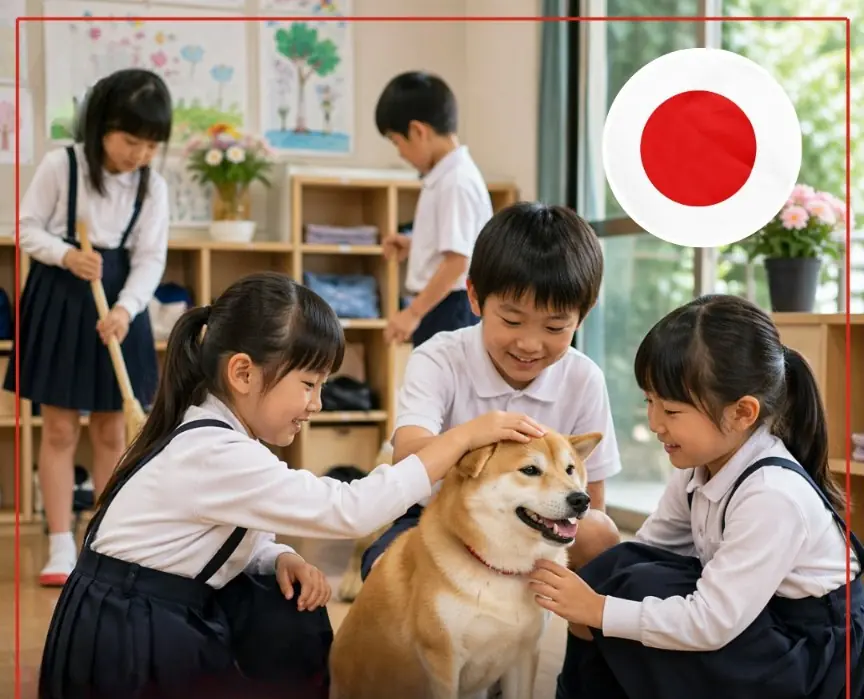
A group of Japanese schoolchildren gently petting and caring for a calm dog while smiling naturally beside one another. No phones. No chaos. Just softness, patience, and kindness.
And alongside the image, one message stands out:
“In Japan, children are first taught to focus on kindness and respect, including compassion towards animals, instead of taking exams.”
Whether people fully agree with the statement or not, the emotional idea behind it clearly touched millions.
Because deep down, many people believe kindness is one of the most important lessons a child can ever learn.
Teaching Compassion Early Changes Everything
Children absorb behavior from the environments around them.
The way adults treat animals, strangers, classmates, and even nature itself often shapes how children eventually interact with the world.
That’s why lessons involving empathy and compassion matter so much during early childhood.
Many educators around the world now believe emotional intelligence is just as important as academic achievement. Teaching children to understand gentleness, patience, responsibility, and respect may influence their relationships for the rest of their lives.
Animals often play a surprisingly powerful role in that process.
When children learn how to care for animals properly, they begin understanding concepts like:
- Vulnerability
- Trust
- Responsibility
- Emotional awareness
- Nonverbal communication
- Gentleness and patience
And unlike grades or test scores, those lessons often stay with people forever.


 8
8
Why Animals Help Children Develop Empathy
Animals naturally encourage emotional connection.
Unlike technology or screens, interacting with animals requires attention, calmness, and emotional sensitivity. Children quickly learn that animals respond to tone, body language, patience, and trust.
A frightened dog cannot be comforted through force.
A shy animal requires gentleness.
A pet depends entirely on humans for safety and care.
Those experiences teach children something important:
Kindness has real impact.
Research in child development has often shown that positive interaction with animals may help children develop empathy, reduce stress, improve emotional regulation, and strengthen social skills.
That’s one reason therapy animals and classroom pets are increasingly used in educational and healthcare environments around the world.
Because compassion itself can be learned and strengthened through experience.
The Japanese Cultural Emphasis on Respect
Japan is often internationally associated with values such as respect, discipline, harmony, and social responsibility.
From a young age, many Japanese children participate in activities that encourage cooperation rather than individual competition alone. Students commonly help clean classrooms, organize shared spaces, and work together in group environments.
The emphasis is often placed not only on academic performance, but also on behavior, responsibility, and consideration for others.
That broader cultural mindset is part of why the image resonates emotionally with so many viewers online.
People aren’t only reacting to the children petting the dog.
They’re reacting to the atmosphere itself.
The calmness.
The gentleness.
The sense of mutual respect.
And honestly, in today’s fast-moving world, those qualities feel increasingly rare and valuable.


 10
10
Many People Feel Modern Childhood Has Become Too Competitive
One reason this image sparked strong emotional reactions is because many adults feel modern education systems place overwhelming pressure on children.
Exams.
Performance rankings.
Constant comparison.
Academic expectations.
While educational achievement absolutely matters, critics argue that emotional development sometimes receives far less attention than it deserves.
That’s why messages centered around kindness often spread rapidly online.
People miss softness.
They miss emotional warmth.
They want children to grow into successful adults, but also compassionate human beings.
And compassion toward animals is often viewed as one of the clearest reflections of empathy overall.
Because the way someone treats vulnerable creatures says a great deal about their character.
Animals Teach Lessons That Books Sometimes Cannot
Some life lessons are difficult to explain in classrooms alone.
But animals often teach them naturally.
A child learns patience while waiting for a nervous dog to trust them.
They learn gentleness while holding a tiny animal carefully.
They learn responsibility through feeding, cleaning, and caring routines.
And perhaps most importantly, they learn that love and trust cannot be demanded — they must be earned.
Those emotional lessons shape people in profound ways later in life.
Children who grow up understanding compassion toward animals often become adults who better understand compassion toward people too.
That’s one reason many parents and educators place enormous value on positive animal interaction during childhood.


 6
6
Why This Image Feels So Comforting
At its core, this image represents something many people quietly wish the world had more of:
Gentleness.
Not aggression.
Not competition.
Not cruelty.
Just simple kindness.
Children smiling while softly caring for a calm dog creates an atmosphere that feels emotionally safe and hopeful. It reminds people that compassion is not weakness.
It’s strength.
And maybe that’s why so many viewers connected with the message emotionally, even beyond the specifics of education systems or cultural differences.
Because regardless of country or background, most people understand one universal truth:
A child who learns kindness early carries that lesson into every relationship later in life.
Including the way they treat animals, strangers, friends, and the world itself.
And honestly, that may be one of the most important forms of education anyone can ever receive.