The Canadian Lynx: Nature’s Silent Master of Winter
The Canadian Lynx: Nature’s Silent Master of Winter
Deep within the frozen forests of North America lives a predator so perfectly adapted to snow and silence that it almost feels unreal.
The Canadian lynx does not roar like a lion.
It does not hunt in packs like wolves.
It rarely even allows humans to see it.
Instead, it moves like a ghost through winter landscapes — silent, patient, and almost invisible against the endless snow.
Everything about this animal seems engineered specifically for survival in brutal cold environments. From its oversized paws to its thick silver fur and piercing eyes, the Canadian lynx is not simply a wild cat surviving winter.
It is a creature built by evolution to master it.


 7
7
A Cat Designed for Snow
At first glance, the Canadian lynx looks almost mythical.
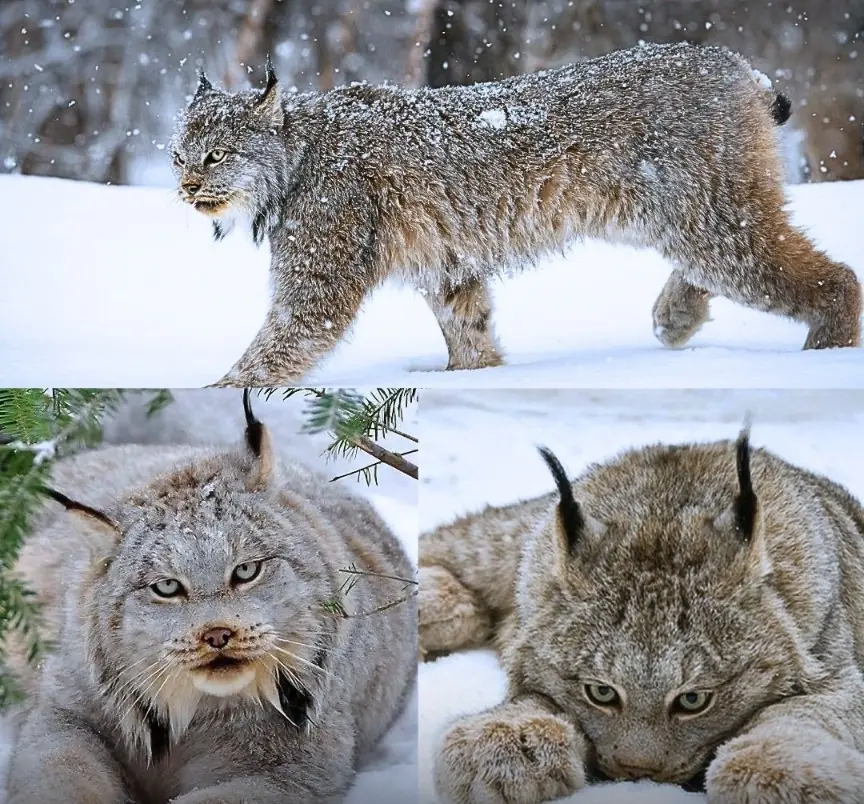
Its thick fur traps warmth against freezing temperatures. Black ear tufts sharpen its distinctive silhouette. Wide paws act almost like natural snowshoes, allowing the animal to walk across deep snow without sinking the way heavier predators often do.
Those oversized paws are one of the lynx’s greatest advantages.
While many animals struggle through harsh winter terrain, the lynx glides across snow with remarkable efficiency. This gives it a major hunting advantage, especially when chasing prey already exhausted by difficult conditions.
Nature rarely creates features by accident.
Every part of the Canadian lynx serves a purpose.
The Predator You Rarely See
One reason the lynx fascinates wildlife researchers is because it is extremely elusive.
Even in regions where lynx populations exist, spotting one in the wild is considered rare. These cats avoid humans whenever possible and prefer remote forests far away from civilization.
Most of their lives unfold unseen:
- moving quietly through snowy woods
- stalking prey in silence
- resting beneath dense forest cover
- traveling alone across vast territories
Unlike louder predators, the lynx depends heavily on stealth rather than intimidation.
Its survival strategy is based on patience and precision.


 7
7
Built Around One Critical Relationship
The survival of the Canadian lynx is deeply connected to another animal: the snowshoe hare.
Snowshoe hares make up the majority of the lynx’s diet, and over thousands of years, the predator evolved specifically to hunt them in snowy environments.
Interestingly, the populations of both animals often rise and fall together in natural cycles.
When hare populations increase:
- lynx numbers often grow
When hare populations decline:
- lynx populations frequently struggle
This relationship is considered one of the most famous predator-prey dynamics in ecology.
It demonstrates how deeply connected ecosystems truly are. The fate of one species can directly shape the survival of another.
Why Their Feet Are So Special
The Canadian lynx’s enormous paws are often compared to snowshoes for good reason.
These paws:
- distribute body weight more evenly
- prevent deep sinking into snow
- improve balance on icy surfaces
- reduce energy loss during movement
This allows the lynx to move efficiently even during severe winters when many animals become slower and weaker.
Predators that cannot adapt to snow often waste valuable energy struggling through deep terrain.
The lynx turns that same environment into an advantage.
A Hunter of Silence
Unlike cheetahs built for explosive speed or wolves relying on teamwork, the lynx hunts through stealth.
It waits.
Observes.
Moves carefully.
Then strikes with sudden precision.
The thick winter forest becomes the perfect environment for ambush hunting. Snow absorbs sound, dense trees create cover, and the lynx’s fur blends naturally into pale surroundings.
In many cases, prey may never realize danger is nearby until the attack begins.
That silent efficiency is exactly why the lynx earned its reputation as one of winter’s most specialized predators.


 6
6
Why Humans Are So Fascinated by Lynx
There is something uniquely mysterious about lynx.
Unlike animals commonly seen in zoos or documentaries, lynx often remain hidden from human eyes. That secrecy creates fascination.
They represent wilderness in its purest form:
- untouched
- quiet
- independent
- unpredictable
Their intense stare, silent movements, and solitary lifestyle make them feel almost ancient — like creatures from another era surviving quietly beyond human attention.
People often associate big cats with tropical jungles or savannas, but the Canadian lynx proves predators can become just as extraordinary in frozen environments.
The Challenges Lynx Face Today
Although Canadian lynx still exist across parts of North America, they face growing environmental pressures.
Major threats include:
- habitat fragmentation
- climate change
- deforestation
- reduced snow cover
- declining prey populations
Climate change is especially concerning because the lynx depends heavily on deep snowy ecosystems where its physical adaptations provide an advantage.
As winters become shorter or less predictable in some regions, competing predators may move into areas previously dominated by lynx.
Protecting forests and maintaining healthy ecosystems remain critical for their survival.


 7
7
Nature’s Perfect Winter Machine
The Canadian lynx is a reminder that evolution can produce extraordinary specialists.
Nothing about this animal feels random:
- the thick insulating fur
- the powerful hind legs
- the oversized paws
- the stealthy movement
- the patient hunting style
Each feature works together like components of a perfectly engineered survival system.
Nature did not simply create a beautiful animal.
It shaped a predator capable of thriving where temperatures fall below freezing and survival becomes brutally difficult.
The Ghost of the Northern Forest
Most people will never see a Canadian lynx in the wild.
And honestly, that mystery may be part of what makes the animal so unforgettable.
Somewhere in the frozen forests, beneath falling snow and silent trees, the lynx continues moving almost invisibly through its ancient territory.
Quiet.
Watchful.
Perfectly adapted.
Not merely surviving winter — but ruling it.