The Hawaiian Happy Face Spider: Nature’s Tiny Smiling Mystery
The Hawaiian Happy Face Spider: Nature’s Tiny Smiling Mystery
At first glance, it looks fake.
A tiny yellow spider with what appears to be a perfectly drawn smiley face on its body sounds more like internet mythology than real biology. Most people assume the images must be edited, painted, or generated by artificial intelligence.
But the truth is even stranger.
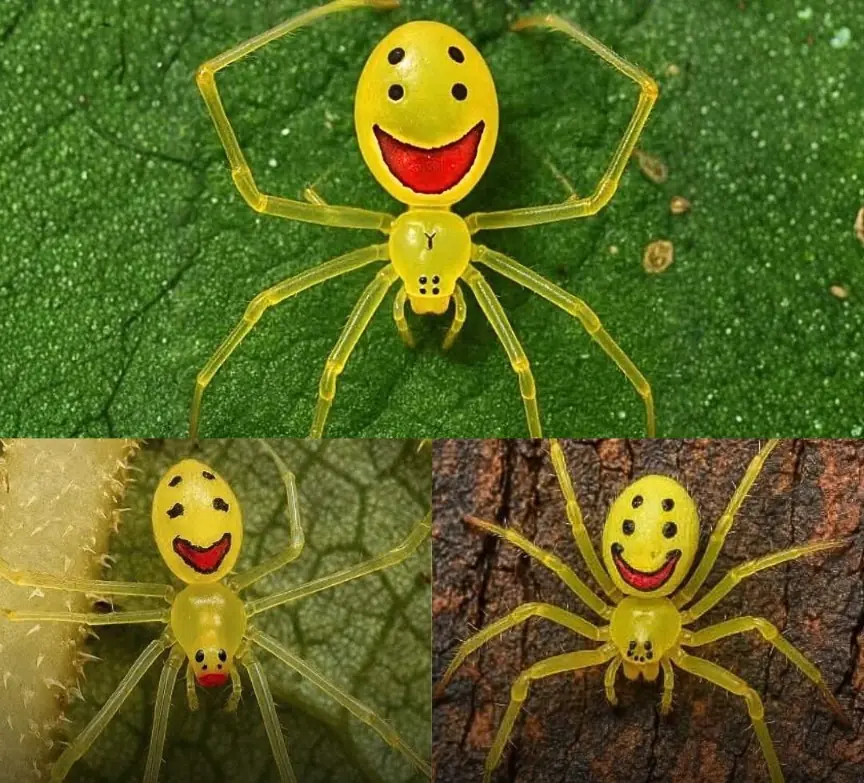
The Hawaiian Happy Face Spider is completely real — and its bizarre smile-like markings are naturally occurring patterns created by pigmentation on its translucent body.
Even more fascinating?
No two spiders look exactly alike.
Some display giant smiling faces. Others have abstract patterns, tiny dots, or markings that resemble masks, emojis, or strange little expressions. Every individual looks slightly different, turning this tiny spider into one of nature’s most surreal works of art.


 6
6
A Spider Found Nowhere Else on Earth
The Hawaiian Happy Face Spider, scientifically known as Theridion grallator, exists only in Hawaii.
More specifically, it lives in the remote rainforests of islands such as:
- Maui
- Oahu
- Molokai
- Hawaii Island
These spiders are extremely small, often measuring less than a quarter inch long. Because of their size and isolated habitat, most people living in Hawaii will never even notice one in the wild.
Yet despite being tiny, they became internationally famous because of one unbelievable feature:
their smiling patterns.
Why Does the Spider Have a Smiley Face?
Scientists still study exactly why these markings evolved, but researchers believe the patterns may help protect the spider from predators.
One theory suggests the bright colors and strange markings confuse birds or insects that might otherwise attack them. Another possibility is that the patterns mimic reflections or distort the spider’s body outline, making it harder to identify as prey.
Interestingly, the spider’s appearance changes dramatically between individuals.
Some are bright yellow with clear smiley faces. Others may display:
- red markings
- black spots
- broken patterns
- almost transparent bodies
- shapes resembling masks or skulls
This variation comes from genetics and natural pigmentation.
Nature essentially creates a different design for every spider.


 7
7
One of Nature’s Strangest Illusions
Part of what makes the Happy Face Spider so fascinating is how human brains automatically recognize faces in random patterns.
This psychological effect is called pareidolia — the tendency to see familiar shapes, especially faces, where none intentionally exist.
Humans experience this constantly:
- faces in clouds
- faces on tree bark
- faces in food
- faces on buildings
- faces in shadows
The Happy Face Spider triggers that instinct perfectly.
Its markings resemble cartoon expressions so strongly that people instantly connect emotionally to it, even though the spider has absolutely no awareness of looking “happy.”
Ironically, the spider’s accidental cuteness may have helped it become one of the most beloved arachnids in the world.
Tiny, Fragile, and Surprisingly Important
Despite their cheerful appearance, these spiders face serious environmental threats.
Because they exist only in Hawaii, they are extremely vulnerable to:
- habitat destruction
- invasive species
- climate change
- ecosystem disruption
Hawaii contains some of the world’s most unique ecosystems because of its geographic isolation. Many species evolved there independently over millions of years and exist nowhere else on Earth.
That uniqueness also makes them fragile.
When invasive predators or environmental changes enter isolated ecosystems, native species often struggle to survive because they never evolved defenses against those threats.
The Happy Face Spider is one small example of how extraordinary and delicate island biodiversity can be.


 6
6
Why People Love This Spider So Much
Most spiders inspire fear.
But the Hawaiian Happy Face Spider somehow achieved the impossible: it made people smile instead of panic.
Its tiny size, bright colors, and face-like markings completely change how humans emotionally react to it. Instead of appearing threatening, it looks oddly friendly — almost like nature accidentally designed a living cartoon character.
That emotional reaction matters more than people realize.
Animals and insects that humans emotionally connect with often receive greater conservation attention and public support. A species that captures imagination can inspire curiosity about science, ecosystems, and biodiversity.
In a strange way, this little smiling spider became an ambassador for Hawaii’s fragile rainforest habitats.
Nature Is More Creative Than Fiction
One reason stories like this spread so rapidly online is because they remind people how bizarre the natural world truly is.
Humans often assume extraordinary creatures only exist in fantasy movies or science fiction. Yet reality continuously produces animals stranger than imagination:
- octopuses changing color instantly
- fish glowing in darkness
- frogs transparent enough to see organs through skin
- spiders carrying natural smiley faces
The deeper scientists explore ecosystems, the more unbelievable life on Earth becomes.
And somehow, one of the weirdest examples is a tiny spider smiling quietly from a rainforest leaf.


 7
7
A Reminder Hidden in a Tiny Creature
The Hawaiian Happy Face Spider may be small, but it represents something much larger.
It reminds humanity that:
- nature still holds mysteries
- biodiversity matters
- even tiny species can be extraordinary
- beauty exists in unexpected places
Most people will never encounter this spider in person.
Yet somewhere in Hawaii’s forests, hidden among wet leaves and tropical plants, these tiny smiling creatures continue existing quietly — each carrying its own unique pattern painted by evolution itself.
No artist designed them.
No human created those faces.
Nature simply did what it has always done best:
create things stranger and more beautiful than anyone expects.