The “Lost” Egg-Laying Mammal That Reappeared After 62 Years Shocked the Scientific World
The “Lost” Egg-Laying Mammal That Reappeared After 62 Years Shocked the Scientific World


 7
7
For more than six decades, scientists feared it might already be gone forever.
No confirmed sightings.
No clear photographs.
No physical evidence proving it still existed in the wild.
The mysterious creature slowly became one of the world’s most famous “lost species” — an animal so rarely seen that many researchers believed it had likely disappeared before most people even knew it existed.
Then, after 62 years, something extraordinary happened.
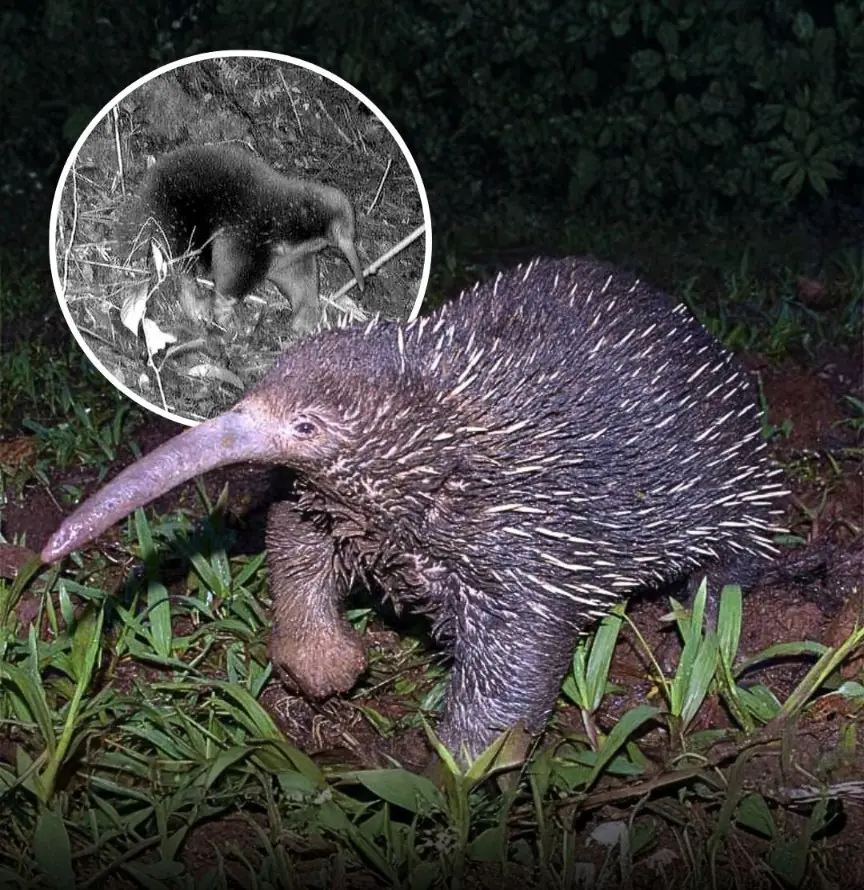
Deep inside the remote forests of Indonesia, hidden camera footage finally captured the unmistakable image of a living long-beaked echidna — one of the strangest and rarest mammals on Earth.
The discovery stunned scientists around the globe.
Because this animal is not just rare.
It belongs to one of the oldest and most unusual groups of mammals still alive today.
A Mammal That Lays Eggs Sounds Impossible — But It’s Real
Most people grow up learning one basic fact:
Mammals give birth to live babies.
But the echidna breaks that rule completely.
Echidnas belong to an ancient group of mammals called monotremes, which are the only mammals on Earth that lay eggs instead of giving live birth. Today, only a few monotreme species remain alive, including the platypus and echidnas.
That alone already makes them scientifically fascinating.
But the long-beaked echidna is even more extraordinary.
Covered in coarse fur and sharp spines, equipped with powerful claws, and carrying an unusually long snout used for detecting prey underground, the animal looks almost prehistoric — like a creature from another era that somehow survived into modern times.
And for decades, almost nobody had seen one alive.
The Species Vanished for More Than Half a Century


 7
7
The species had not been officially documented since the early 1960s.
Over time, researchers worried that habitat destruction, hunting, and environmental changes may have pushed the animal toward extinction. Because the echidna lives in extremely remote mountainous rainforest environments, studying it became incredibly difficult.
Many expeditions searched for signs of survival.
Most found nothing.
That uncertainty transformed the long-beaked echidna into what conservationists call a “lost species” — an animal that may still exist somewhere but has not been scientifically confirmed for many years.
The mystery surrounding the creature only increased public fascination.
People began comparing it to cryptids or mythical animals because sightings became so unbelievably rare.
Yet somewhere deep in the forests, the echidna survived quietly, hidden from the modern world.
The Discovery Happened Through Hidden Camera Traps
The rediscovery did not happen dramatically face-to-face.
Instead, scientists used motion-activated camera traps placed deep in remote rainforest areas. These cameras automatically record wildlife movements day and night without disturbing animals.
For weeks, researchers collected footage from difficult terrain filled with mud, insects, rain, and dense vegetation.
Then finally, the cameras captured something extraordinary.
A long-beaked echidna slowly walked across the forest floor.
The footage confirmed that the species was still alive after more than six decades without verified observation.
For scientists, it was an emotional moment.
Discoveries like this are incredibly rare in modern biology because large mammals almost never disappear completely from scientific observation for such long periods.
The rediscovery immediately became international news.
Why This Animal Is So Important to Science


 6
6
The long-beaked echidna is not important simply because it is rare.
It represents a direct evolutionary link to some of the earliest mammals on Earth.
Monotremes split from other mammals millions of years ago, meaning echidnas preserve ancient biological traits rarely seen in modern animals. Scientists study them to better understand how mammals evolved over time.
Their biology is astonishingly unusual:
- They lay eggs
- They produce milk without nipples
- They detect electrical signals from prey
- They have specialized digging claws
- Their body structure differs dramatically from most mammals
In many ways, echidnas appear almost like a biological bridge between reptiles and mammals.
That evolutionary uniqueness makes protecting them critically important.
Losing such a species would mean losing millions of years of evolutionary history.
Why Rare Species Disappear So Easily
One reason animals like the long-beaked echidna become “lost” is because they survive in isolated habitats that humans rarely enter.
Dense rainforest ecosystems can hide species surprisingly well, especially nocturnal or elusive animals.
However, isolation alone does not guarantee safety.
Many rare species face serious threats including:
- Habitat destruction
- Deforestation
- Climate change
- Hunting
- Human expansion
- Illegal wildlife trade
Animals with small populations are especially vulnerable because even minor environmental disruptions can push them toward extinction quickly.
That is why rediscoveries like this create both excitement and urgency.
Finding the species alive is only the beginning.
Now conservation efforts become even more important.
The Internet Reacted With Amazement

 7
7
When news of the rediscovery spread online, people around the world reacted with disbelief and excitement.
Many could not believe an egg-laying mammal had remained hidden for so long.
Others were fascinated by the animal’s appearance, describing it as a mix between:
- A hedgehog
- An anteater
- A porcupine
- A prehistoric creature
Social media quickly filled with comments calling the echidna “a real-life Pokémon,” “a living fossil,” and “proof nature still hides mysteries.”
The story reminded people that despite modern technology, Earth still contains remote ecosystems filled with species humans barely understand.
That mystery continues captivating the public imagination.
A Reminder That Nature Still Holds Secrets
Perhaps the most extraordinary part of this story is what it says about the planet itself.
Humans often assume the modern world has already been fully explored.
But discoveries like the long-beaked echidna prove otherwise.
Remote forests, deep oceans, mountain ecosystems, and isolated environments still hide countless biological mysteries waiting to be understood.
Some species disappear before scientists even discover them.
Others quietly survive beyond human observation for generations.
The rediscovery of this egg-laying mammal became more than just a scientific event.
It became a symbol of hope.
Hope that rare species can survive.
Hope that conservation efforts matter.
And hope that the natural world still contains wonders capable of surprising humanity.
The “Lost” Mammal That Refused to Disappear
For 62 years, the long-beaked echidna existed almost like a ghost story among scientists — a creature believed by some to be gone forever.
Yet deep inside the rainforest, it endured silently.
Hidden from cameras.
Hidden from humans.
Hidden from history itself.
Until one moment finally revealed the truth.
The last egg-laying mammal once thought lost had never truly vanished at all.