Should the Public Have Access to a Registry of Convicted Animal Abusers?
Should the Public Have Access to a Registry of Convicted Animal Abusers?
Few things make people as emotional as stories involving animal cruelty.
For many, animals represent innocence, loyalty, trust, and unconditional love. So when cases of abuse surface online, the reaction is often immediate and intense. People don’t just feel anger — they feel heartbreak.
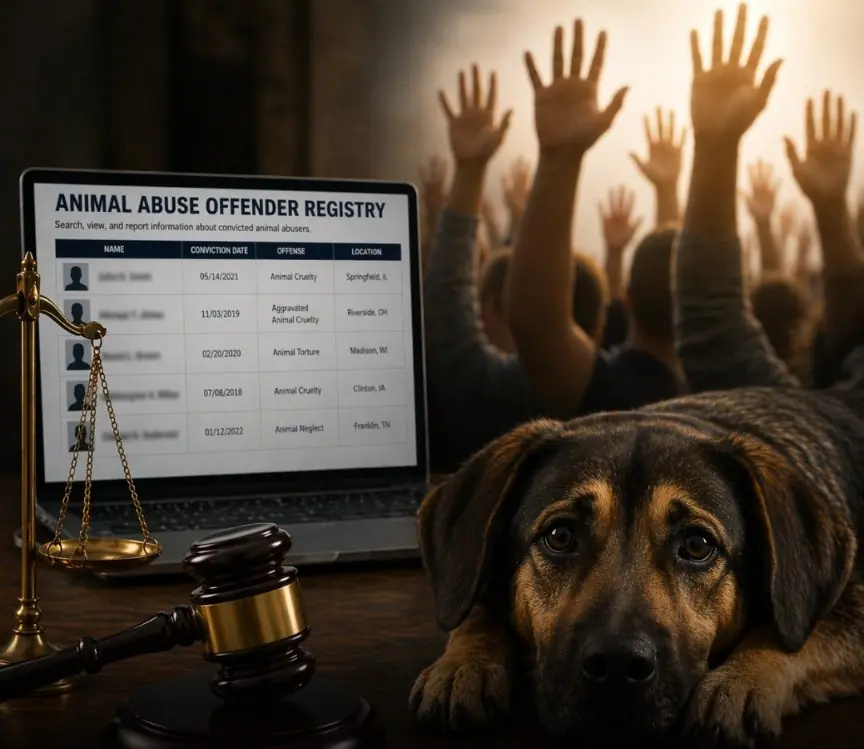
That’s exactly why this image has sparked such strong discussion online.
A sad-looking dog lying beside a courtroom gavel and a computer screen displaying an “Animal Abuse Offender Registry,” while hands rise in the background as if an entire crowd is demanding accountability.
And beneath it, one powerful question:
“Should the public have access to a registry of convicted animal abusers?”
For a growing number of people, the answer feels obvious.
But the conversation surrounding public registries is far more complex than many realize.
Why People Support Public Registries
Supporters of animal abuse registries often argue that convicted offenders pose ongoing risks not only to animals, but potentially to broader public safety as well.
Studies and criminal investigations over the years have repeatedly suggested links between severe animal cruelty and other forms of violent behavior. Many experts believe patterns of abuse toward animals can sometimes indicate deeper behavioral or psychological issues.
Because of that, advocates argue that public awareness matters.
They believe shelters, rescues, breeders, pet adoption organizations, and even neighbors should have access to information about individuals convicted of serious animal cruelty offenses.
The reasoning is straightforward:
- It may help prevent repeat offenses
- It could discourage future abuse
- It allows rescues and shelters to screen adopters more carefully
- It increases accountability for convicted offenders
- It sends a strong societal message that animal cruelty is taken seriously
To many animal lovers, protecting vulnerable animals outweighs concerns about public discomfort for convicted abusers.


 5
5
The Emotional Reality Behind Animal Cruelty Cases
Part of why these discussions become so emotionally charged is because animal cruelty cases often deeply disturb the public.
Animals are entirely dependent on humans for care and protection in domestic environments. When that trust is broken through neglect, violence, abandonment, or torture, people naturally react strongly.
For many pet owners, it’s impossible not to imagine their own dog or cat in that situation.
That emotional connection fuels public demand for stronger laws and more transparency.
Online communities dedicated to animal welfare have grown massively over the past decade. Social media has amplified awareness of abuse cases, rescue stories, and adoption efforts in ways never seen before.
And increasingly, people are asking:
“Why should convicted animal abusers remain anonymous if the victims cannot speak for themselves?”
That question sits at the center of the debate.
Some Places Already Have Registries
Although not widespread globally, some jurisdictions have experimented with animal abuse registries in different forms.
These systems are generally intended to track individuals convicted of animal cruelty offenses, especially repeat offenders. In some cases, shelters and adoption agencies may use background checks to prevent animals from being placed into potentially dangerous homes.
Supporters compare the idea to other public safety databases designed to inform communities about specific categories of offenders.
However, laws and policies vary significantly depending on the country, state, or region.
Some proposals focus only on severe felony-level abuse cases, while others discuss broader inclusion criteria.
The debate becomes especially complicated when balancing:
- Public safety
- Privacy rights
- Rehabilitation opportunities
- Legal fairness
- Prevention of harassment or vigilantism
Because while emotions surrounding animal cruelty are extremely strong, legal systems still require careful balance.


 6
6
The Argument Against Public Registries
Not everyone agrees that public registries are the right solution.
Critics raise concerns about privacy, due process, and the long-term consequences of public exposure after someone has already completed legal penalties.
Some argue that permanent public registries could make rehabilitation harder and increase risks of harassment or threats. Others worry about inconsistent laws, wrongful accusations, or varying definitions of neglect versus intentional cruelty.
There’s also debate about whether public shaming actually reduces repeat offenses in meaningful ways.
These concerns don’t mean critics support animal abuse.
Rather, they question whether public databases are the most effective or legally balanced approach.
Some experts instead advocate for:
- Stronger sentencing laws
- Mandatory psychological evaluations
- Ownership bans after convictions
- Better funding for animal welfare investigations
- Expanded education on responsible pet care
The conversation remains deeply emotional precisely because both safety and justice are involved.
Why This Topic Resonates So Deeply With People
At its core, this debate is about vulnerability.
Animals cannot report abuse themselves.
They cannot escape dangerous homes easily.
They cannot explain suffering in words.
That reality creates an intense emotional response in people who care about animal welfare.
Dogs especially hold a unique emotional place in many cultures because of their loyalty, companionship, and trust toward humans. Seeing a frightened or abused dog often triggers powerful protective instincts.
That’s exactly why images like this spread so rapidly online.
The sad eyes of the dog in the photo symbolize something larger than one individual animal.
They represent every vulnerable creature relying on humans for safety.


 7
7
A Growing Global Conversation
Whether people fully support public registries or not, one thing is clear:
Society’s attitude toward animal cruelty is changing.
Animals are increasingly viewed not simply as property, but as living beings deserving protection, care, and compassion.
Public awareness surrounding abuse, neglect, puppy mills, illegal breeding operations, and abandonment has expanded dramatically through social media and rescue organizations.
And with that awareness comes stronger demands for accountability.
Many people now believe protecting animals should be treated as a serious public responsibility rather than a secondary issue.
That cultural shift is likely why this image resonates with so many viewers.
Because underneath the legal debate lies something deeply emotional and universal:
The belief that creatures capable of love, trust, and loyalty deserve to feel safe in the hands of humans.
And for millions of people around the world, protecting that trust feels worth fighting for.