Little Punchy’s Transformation From Lonely Orphan to Beloved Family Member Has Everyone Emotional
Little Punchy’s Transformation From Lonely Orphan to Beloved Family Member Has Everyone Emotional


 7
7
Sometimes the most powerful transformations aren’t about becoming stronger.
They’re about finally belonging somewhere.
And honestly, few stories show that better than little Punchy’s journey.
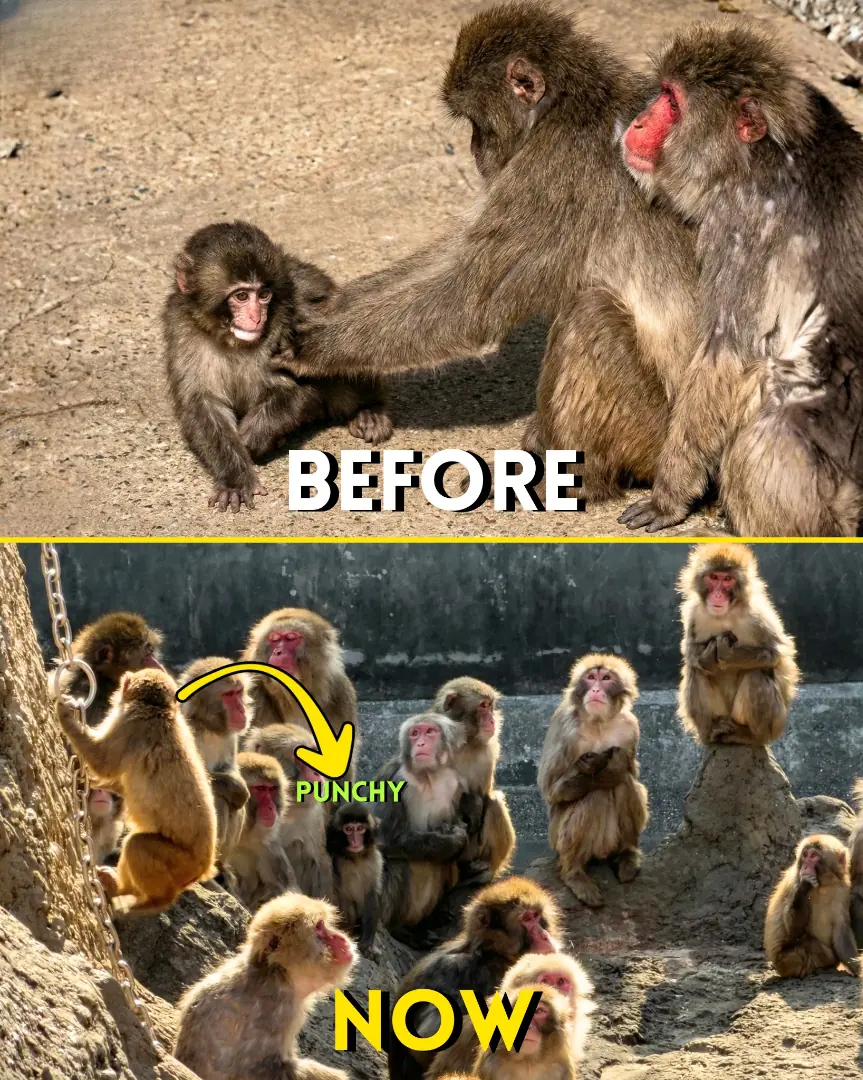
The emotional side-by-side images showing Punchy “before” and “now” have deeply touched people online because they reveal something heartbreaking and beautiful at the same time: the difference between surviving alone and finally feeling accepted.
In the top photo labeled “Before,” the tiny orphan monkey looks isolated and uncertain as an older macaque physically pushes him away from the group.
In the bottom “Now” image, everything feels different.
Punchy is no longer standing awkwardly on the outside.
He’s sitting right in the middle of the troop like he has always belonged there.
And for people who have followed his journey, that single change says absolutely everything.
Life Was Extremely Hard for Tiny Punchy
For orphaned baby monkeys, survival inside a troop can be incredibly difficult.
In macaque society, mothers are everything.
They provide:
- protection
- comfort
- warmth
- social status
- guidance
- and safety from dominant adults
Without a mother nearby, young monkeys often become vulnerable targets. They stay low in the social hierarchy and may struggle to integrate naturally into group dynamics.
That reality becomes painfully visible in the “Before” image.
Punchy looks tiny.
Uncertain.
Almost hesitant to even exist near the others.
And then comes the heartbreaking moment: an older monkey pushes him away as if reminding him he doesn’t belong there.
For many viewers, that image genuinely hurt to look at.
Because even across species, rejection feels universal.
The Saddest Part Was His Loneliness


 7
7
When Punchy first became known online, many people focused on how adorable he was.
But underneath the cuteness was actually a very emotional reality:
he was alone.
Without a mother constantly protecting him, every interaction inside the troop carried uncertainty. Baby monkeys normally spend nearly all their time physically attached to their mothers during early development.
Punchy didn’t have that security.
Instead, he often relied on blankets, caretakers, and his famous “Mama Doll” for emotional comfort.
And honestly, seeing such a tiny orphan trying to navigate a complicated monkey society alone made people incredibly protective of him.
Because despite being small and vulnerable, he kept trying.
He kept approaching the group.
Kept learning.
Kept searching for connection.
Even after being pushed away.
Then Slowly, Everything Started Changing
The transformation didn’t happen overnight.
Trust inside animal groups takes time, especially for young orphans trying to integrate socially. Older monkeys needed time to become familiar with Punchy’s presence, and Punchy himself had to build confidence little by little.
But eventually, subtle changes began appearing.
He started sitting closer.
Playing more freely.
Exploring without fear.
And most importantly, the troop slowly stopped treating him like an outsider.
That emotional shift becomes crystal clear in the “Now” image.
Instead of sitting isolated at the edges, Punchy now rests directly in the middle of the group surrounded by larger adult monkeys.
And somehow, that one simple image feels unbelievably powerful.
Because he no longer looks like he’s asking permission to exist there.
He just belongs.
The Difference Between “Trying to Belong” and “Belonging”


 7
7
That’s what affected people most emotionally.
In the first image, Punchy looks cautious and uncertain.
In the second, he looks calm.
Relaxed.
Safe.
The change isn’t just physical.
It’s emotional.
Before, he was trying to find a place within the troop.
Now, he has one.
And honestly, that idea resonates deeply with humans too.
Everyone understands what it feels like to be excluded.
And everyone understands how life changes once you finally feel accepted somewhere.
That’s why the images spread so quickly online.
People weren’t just seeing monkeys.
They were seeing resilience, healing, and belonging.
His Mama Doll Helped Him Survive
Longtime followers of Punchy’s story remember how attached he once was to his Mama Doll — the comforting stuffed object he clung to constantly after losing his mother.
For orphaned baby primates, transitional comfort objects can become emotionally important because they provide a sense of safety during stressful development periods.
Punchy held onto that doll everywhere.
It became his emotional anchor when the world still felt uncertain.
But now, something beautiful has happened:
He doesn’t seem to need it nearly as much anymore.
Not because he forgot his pain.
But because he gained something stronger.
Connection.
Now He Has Something Better Than Survival


 7
7
The final line of Punchy’s story is what truly broke the internet emotionally:
“He has a family.”
And honestly, after everything he’s been through, that sentence feels enormous.
Punchy no longer survives by hiding quietly in corners hoping not to be noticed.
Now he sits confidently among the troop.
Now he experiences social comfort.
Now he feels protected.
Now he belongs somewhere.
That transformation reflects not only the resilience of the tiny monkey himself, but also the incredible patience of caretakers and the gradual acceptance of the troop around him.
Why Millions Feel Emotionally Attached to Him
Punchy’s journey resonates because it mirrors something deeply human.
At its core, his story isn’t really about monkeys.
It’s about loneliness.
Healing.
Acceptance.
And the universal need to feel loved and safe somewhere in the world.
Watching him evolve from a frightened orphan sitting at the edge of the group into a confident little monkey resting peacefully in the center feels emotionally satisfying in a way people instantly understand.
Because deep down, everyone wants what Punchy finally found:
A place where they no longer feel unwanted.
A place where they can relax.
A place where they’re accepted exactly as they are.