Little Punchy Loves His Dads So Much… And Honestly, He Looks Like a Tiny Child Trying Not to Be Left Behind
Little Punchy Loves His Dads So Much… And Honestly, He Looks Like a Tiny Child Trying Not to Be Left Behind
If there’s one thing everybody on Monkey Mountain knows by now, it’s this:
Little Punchy absolutely refuses to stay away from the humans he loves.
And honestly?
These photos might be the clearest proof yet.
Because the moment Punchy sees his dads nearby, he immediately transforms into the clingiest, most dramatic tiny monkey imaginable. Suddenly he’s jumping, reaching, climbing, and doing everything possible to get their attention like a little kid terrified the family is leaving without him.
And honestly, it’s impossibly cute.


 6
6
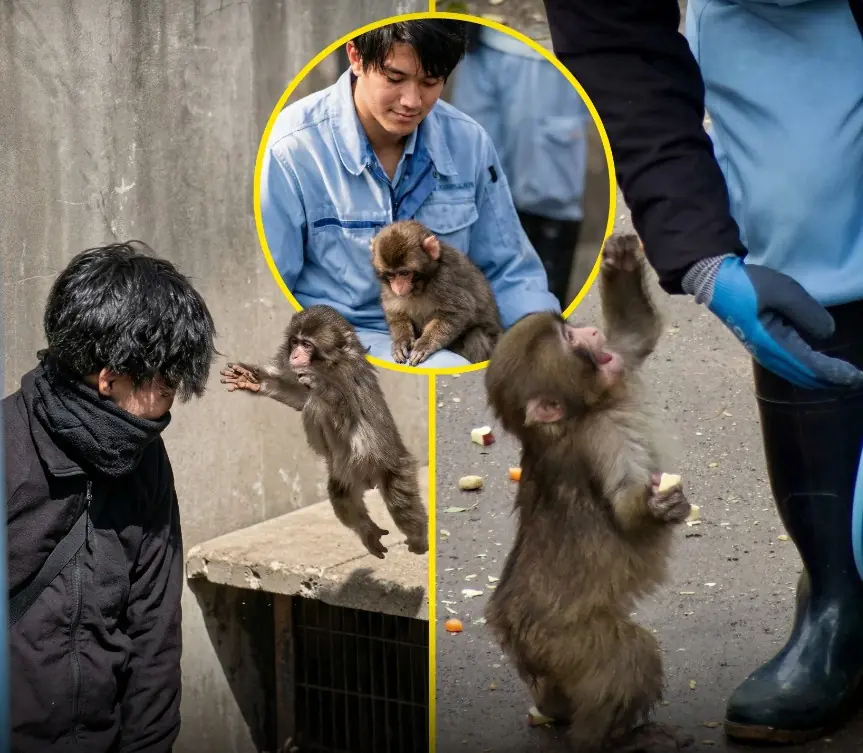
The left photo especially feels emotional because Punchy looks completely focused on his dad. Tiny arms stretched forward, little body lifted off the ground mid-jump, eyes locked directly onto him like nothing else in the world matters at that moment.
That isn’t random behavior.
That’s attachment.
Baby monkeys naturally stay physically close to trusted parental figures because closeness equals safety in their emotional world. Young macaques instinctively climb onto, follow, and reach toward the individuals they trust most. Physical contact is reassurance for them.
And honestly, considering Punchy’s history, it makes perfect sense why his attachment became so strong.
When he was first abandoned, he had almost nobody.
No mother to carry him.
No warm body protecting him.
No stable emotional security.
So the humans who cared for him during that vulnerable period became incredibly important psychologically. They weren’t just feeding him or watching over him.
They became safety itself.

 7
7
The circle photo in the middle honestly says everything too.
Punchy sitting quietly beside his dad looks so calm and emotionally secure there. No fear. No stress. No loneliness.
Just peace.
And people who followed his story from the beginning understand exactly why that matters so much.
Because early Punchy rarely looked relaxed.
Back then, he constantly seemed emotionally overwhelmed by the world around him. He hid often. Stayed tense around other monkeys. Clung desperately to his Mama Doll because it was one of the only things making him feel safe emotionally.
Now?
Now he confidently seeks comfort from real relationships.
Friendships with other monkeys.
Affection from caretakers.
Social closeness.
Love.
That transformation is honestly incredible.

 6
6
Then there’s the right-side image, which honestly might be the funniest and cutest one of all.
Punchy is literally standing upright with both arms stretched upward toward his dad like a toddler demanding to be picked up immediately. Meanwhile food is scattered all over the ground around him, but he barely seems to care because apparently emotional attachment matters more at that moment than snacks.
And honestly?
That says a lot.
Because monkeys are highly social animals, and young monkeys especially prioritize emotional security constantly. Punchy’s behavior here feels almost painfully relatable to humans because it mirrors exactly how small children act toward trusted parents.
“Don’t walk away.”
“Pick me up.”
“Take me with you.”
“I want to stay close.”
That’s exactly the energy he’s giving here.


 8
8
What makes these moments especially emotional is knowing that Punchy’s attachment no longer seems driven purely by fear.
At first, he depended on humans because he was vulnerable and emotionally desperate for stability. But now, even though he has grown socially confident around the monkey group, he still actively chooses closeness with his dads over and over again.
That detail matters.
Because it means the bond survived beyond survival mode.
Now it looks like genuine affection.
Trust.
Comfort.
Familiarity.
And honestly, relationships formed during moments of rescue often become incredibly deep because the emotional imprint happens during the hardest chapter of an animal’s life. The individuals who provide warmth, food, protection, and reassurance during trauma become permanently associated with safety inside the animal’s emotional memory.
Punchy may not understand words.
But his behavior speaks clearly enough.
The jumping.
The reaching.
The following.
The desperate need to stay near them.
All of it says the same thing:
“These are my people.”
And honestly, seeing a once-lonely orphan become this emotionally expressive and attached feels unbelievably heartwarming.
Because there was a time when Punchy had nobody to reach toward.
Now he has people he never wants to let go of.