Orphaned Baby Skunks Raised By Hand Grow Up Wild And Free After Unexpected Spray War
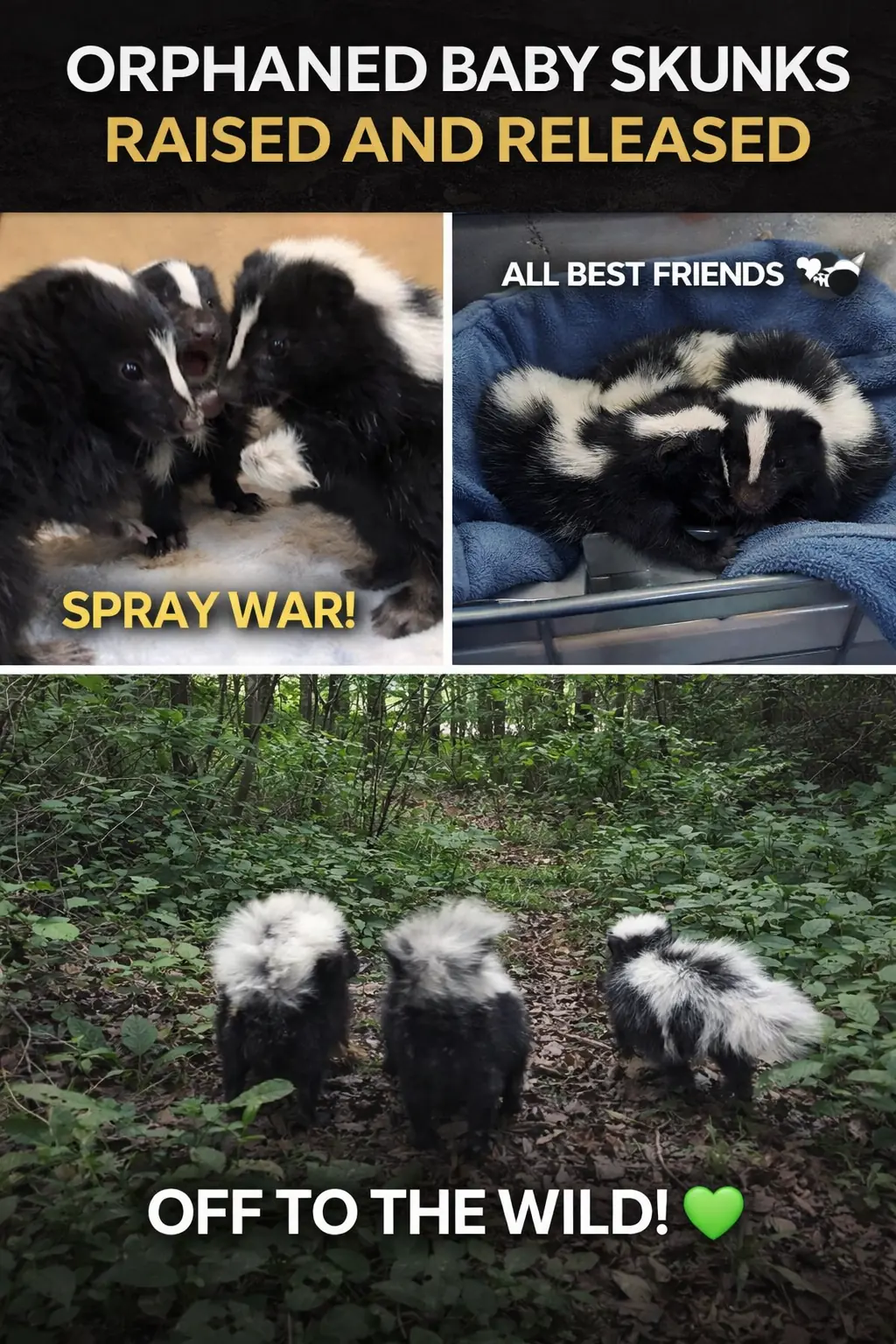
Three orphaned baby skunks rescued at just one week old formed an unlikely family, survived a hilarious spray war, and were successfully released back into the wild.
They Were Just One Week Old — And Completely Alone
When wildlife rescuers first received the call, they weren’t prepared for how tiny the patients would be.
Three orphaned baby skunks — each barely a week old — had lost their mother and were left vulnerable in the wild. At that age, skunks are entirely dependent on their mother for warmth, nutrition and protection. Without immediate intervention, their chances of survival would have been heartbreakingly slim.
So the team stepped in.
Wrapped carefully in soft blankets and placed in a temperature-controlled incubator, the babies began their second chance at life.
And from day one, it was clear:
These little skunks had huge personalities.
Around-the-Clock Care For Fragile Lives
Raising orphaned wildlife is never simple — especially not skunks.
At just one week old:
-
Their eyes are barely open.
-
They cannot regulate body temperature.
-
They require bottle feeding every few hours.
-
They are extremely susceptible to dehydration.
The wildlife rehabilitators became substitute mothers overnight.
Every feeding was scheduled.
Every gram of weight gain was monitored.
Every squeak was analyzed.
Slowly but surely, the babies grew stronger.
Their fur thickened.
Their signature white stripe became more defined.
And their curious nature began to shine.
When A Third Baby Joined — The Drama Began
As if two baby skunks weren’t enough, a third orphan was rescued and brought into the same clinic.
The caregivers hoped the trio would bond instantly.
They were wrong.
The first two skunks had already formed a tight-knit duo. They slept curled together. They ate side by side. They moved as one.
When the third baby arrived, the reaction was immediate:
Suspicious sniffing.
Tiny defensive postures.
Tail flicks.
And then — chaos.
The Infamous Spray War
Yes, baby skunks can spray.
Not as powerfully as adults — but enough.
Within days of their introduction, the clinic experienced what staff now jokingly refer to as “The Great Spray War.”
One baby would get startled.
Another would react.
And suddenly the room would fill with that unmistakable scent.
The smell lingered for days.
Laundry had to be redone.
Air purifiers ran nonstop.
Staff clothes required emergency washing cycles.
But even through the odor, the team knew something important:
This was normal.
Skunks spray as a defense mechanism. It meant their instincts were intact.
And that was exactly what the rehabilitators wanted.
From Bottle Babies To Bold Explorers
As weeks passed, something shifted.
The tension faded.
The trio began sleeping together.
They shared meals peacefully.
They groomed each other.
Bonding had begun.
Soon they were moved to a larger outdoor enclosure designed to mimic natural habitat. There, they learned critical survival skills:
-
Digging for insects
-
Foraging for food
-
Recognizing natural scents
-
Navigating uneven terrain
Instead of relying on bottle feeding, they transitioned to solid foods.
Instead of seeking human comfort, they began choosing independence.
That’s the goal of ethical wildlife rehabilitation:
Not to create pets —
But to restore wild instincts.
Preparing For Release
Releasing wildlife isn’t emotional — it’s strategic.

Before release, rehabilitators assess:
-
Weight and overall health
-
Ability to forage independently
-
Appropriate fear response to humans
-
Sibling social dynamics
The skunks passed every test.
They no longer approached caregivers eagerly.
They preferred exploring the enclosure.
They reacted appropriately to new sounds.
They were ready.
The Day They Ran Free
On release day, the transport carriers were placed at a carefully selected wild location — one with food sources, shelter options and low human disturbance.
The doors opened.
For a split second, the skunks paused.
Then they ran.
Not hesitantly.
Not confused.
Not looking back.
They darted into the brush with confidence, tails raised high.
As if they had never needed help at all.
That’s the quiet success of wildlife rescue:
When the animals forget you.
Why Stories Like This Matter
Skunks often get a bad reputation because of their spray.
But they are:
-
Important ecosystem contributors
-
Natural pest controllers
-
Generally non-aggressive animals
-
Fascinating, intelligent creatures
This rescue story highlights something powerful:
Even animals we misunderstand deserve compassion.
And when given proper care, they can return exactly where they belong — the wild.
The Hidden Work Of Wildlife Rehabilitation
Most people only see the cute photos.
They don’t see:
-
3 a.m. feedings
-
Lingering skunk odor in clinic walls
-
Sleepless nights worrying over weight loss
-
The heartbreak of letting go
But rehabilitators do it anyway.
Because the goal isn’t ownership.
It’s restoration.
A Spray War, A Bond, A Second Chance
From week-old orphans to confident wild skunks, their journey is proof of what patience and expert care can accomplish.
They arrived helpless.
They left unstoppable.
And somewhere in the forest, three striped shadows are now digging, foraging and living exactly as nature intended.
Wild.
Free.
And thriving.