Imagine Being Born Before Electricity — and Still Casually Crunching Salad Today
The Extraordinary Life of Jonathan, the World’s Oldest Living Land Animal
Imagine being born before electricity was a thing.
Before light switches.
Before cars.
Before airplanes crossed the sky.
And now imagine still being alive — calmly chewing lettuce — while the world scrolls past you at impossible speed.
That is everyday life for Jonathan.
Jonathan is a Seychelles giant tortoise believed to be around 193 years old, making him the oldest known living land animal on Earth. His life stretches across centuries so vast that history books struggle to hold it all — yet he remains exactly where he’s always been, unhurried and quietly extraordinary.
Born Into a World That No Longer Exists
Jonathan is estimated to have hatched around 1832.
At that time, there were no electric lights glowing in homes. No telephones ringing. No engines roaring through streets. The world moved at the pace of horses, ships, and handwritten letters.
Queen Victoria had not yet taken the throne. Photography was still new. Most people would never leave the place they were born.
Jonathan began his life long before the modern world learned how to rush.
A Tortoise Who Watched Empires Rise and Fall
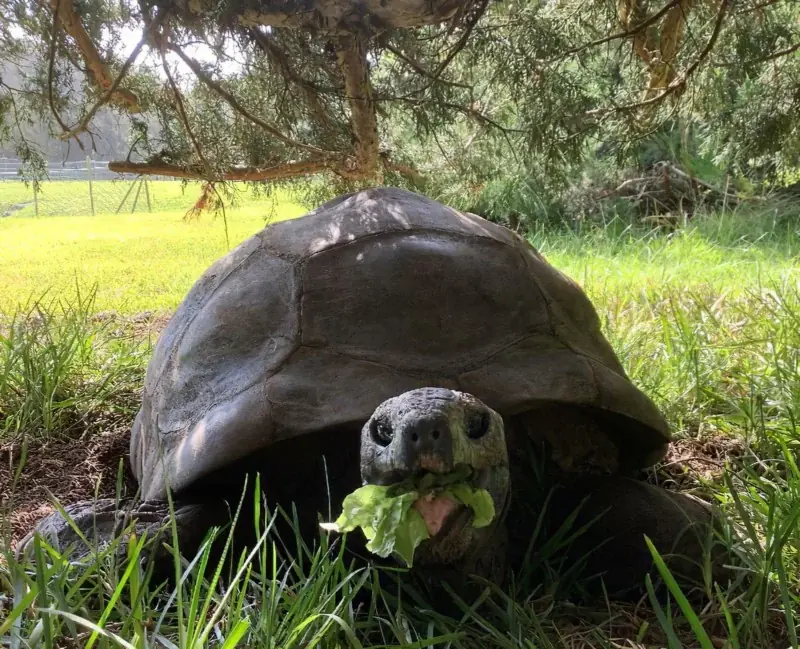
Today, Jonathan lives on the remote island of Saint Helena, a tiny dot in the South Atlantic Ocean. He slowly wanders the manicured lawns of Plantation House, the official residence of the island’s governor.
It’s a peaceful life — and one he’s lived for a very long time.
Jonathan arrived at Plantation House in 1882, already fully grown. That single detail changed everything. Because tortoises grow slowly and reach maturity after many decades, caretakers realized he must already have been old even by Victorian standards.
Working backward, scientists estimated his birth year to be around 1832.
Which means Jonathan has lived through:
-
The fall of empires
-
Two World Wars
-
The invention of cars, airplanes, and computers
-
The moon landing
-
The rise of the internet
-
And more than 30 different governors coming and going
Through it all, Jonathan stayed.
The Stillness That Outlasts History
While humans rushed to invent faster ways of living, Jonathan perfected the art of remaining.
He watched uniforms change. Flags change. Faces change.
Time moved loudly around him — but never through him.
Visitors often describe an almost surreal feeling standing near Jonathan. He doesn’t rush away. He doesn’t react dramatically. He simply exists, solid and patient, as if the centuries mean nothing at all.
And in a way, maybe they don’t.
The Body of a Survivor
Time has left its marks.
Jonathan is now blind due to cataracts.
He has lost his sense of smell.
His movements are slower than ever.
But his hearing remains sharp.
Caretakers say that when Jonathan hears familiar voices approaching, his head lifts. He responds to sound — proof that even after nearly two centuries, connection still matters.
To keep him healthy, the island’s veterinarian hand-feeds him once a week. His favorite foods include:
-
Lettuce hearts
-
Cabbage
-
Cucumbers
-
Carrots
-
Apples
-
And the occasional banana — which often sticks to his mouth but remains a favorite anyway
It’s not a glamorous diet. But it’s consistent. Gentle. Nourishing.
Just like his life.
Not as Alone as You’d Think
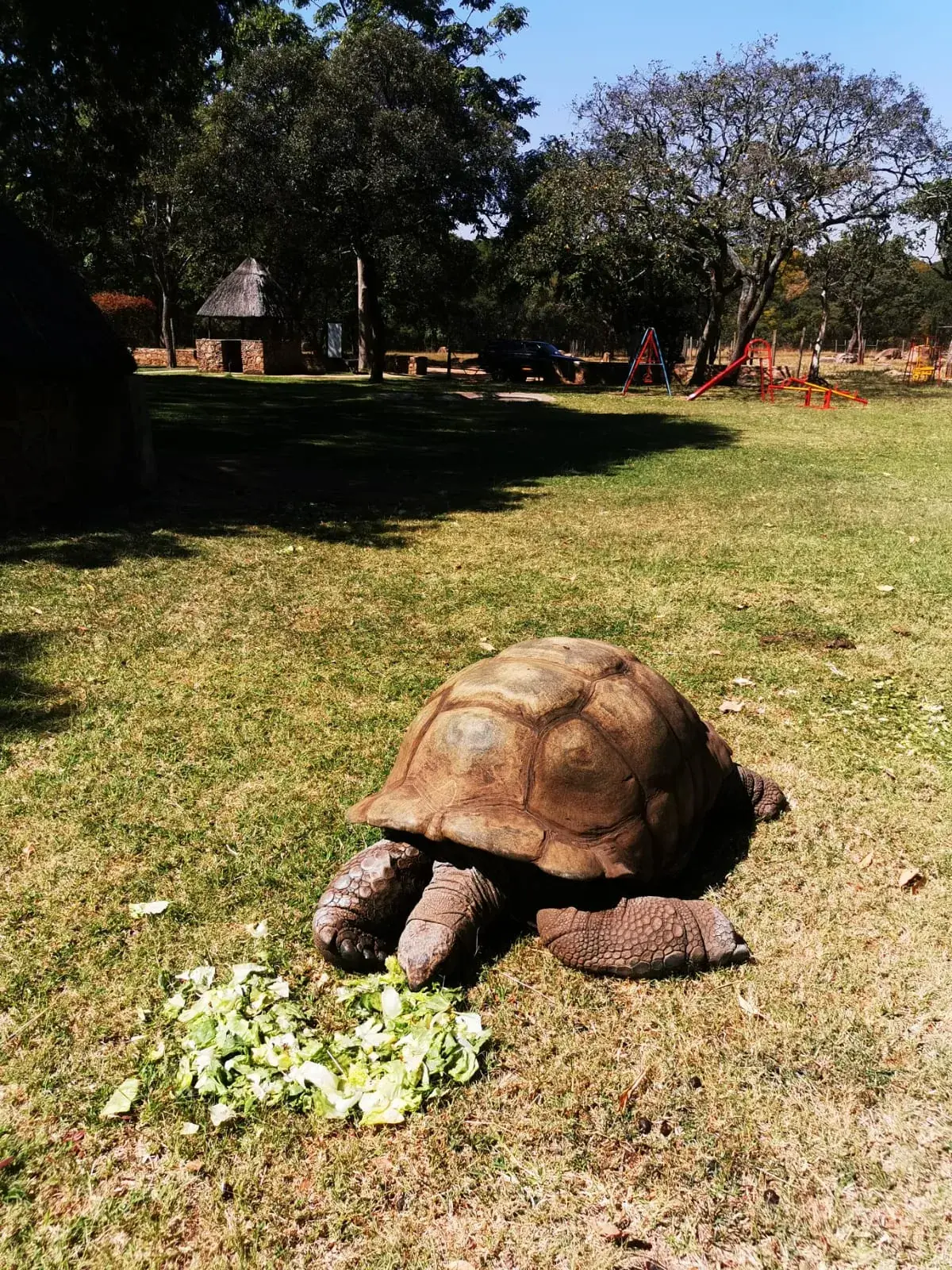
Despite his age, Jonathan isn’t a solitary figure.
He shares his paddock with three other giant tortoises: Emma, David, and Frederik. Together, they sunbathe, nap, and move slowly across the grass in companionable silence.
And here’s the detail that surprises almost everyone:
Jonathan still has a pretty active love life.
Caretakers have joked that age has not dulled his enthusiasm. Even after nearly two centuries, some instincts remain timeless.
A Scientific Mystery in a Shell
An animal living this long is almost unheard of.
Because of Jonathan, scientists are deeply interested in what his body might reveal about aging, longevity, and resilience. How have his cells endured so long? What protected his organs? How did his environment shape his lifespan?
While no single answer exists, experts believe several factors play a role:
-
A slow metabolism
-
A calm, stress-free environment
-
A simple, plant-based diet
-
Consistent care and protection
-
And the natural longevity of giant tortoises themselves
Jonathan is living evidence that aging doesn’t have to mean decline — it can also mean endurance.
The Power of Slow Living
Jonathan has never chased anything.
He doesn’t hurry.
He doesn’t multitask.
He doesn’t compete.
He eats when he’s hungry.
He rests when he’s tired.
He basks in the sun when it’s warm.
In a world obsessed with productivity and speed, Jonathan offers a radically different model of success.
One measured not in achievements — but in presence.
Why Jonathan Captivates Us
People don’t fall in love with Jonathan just because he’s old.
They love him because he represents something we’ve lost.
Patience.
Continuity.
A life not dictated by urgency.
Jonathan reminds us that time does not always need to be conquered. Sometimes, it can simply be inhabited.
A Living Witness to Human Change
Jonathan has seen humanity at its best and worst — even if only indirectly.
He lived while humans fought wars, crossed oceans, reshaped continents, and rewrote the rules of existence.
Yet through all of it, he remained unchanged.
Perhaps that’s why his story feels so grounding. While everything else feels fragile and fast, Jonathan stands as proof that not everything is meant to break.
The Quiet Lesson Jonathan Teaches
Jonathan doesn’t offer advice.
He doesn’t speak.
He doesn’t perform.
He just keeps living.
And somehow, that’s enough to make people stop and think.
Imagine This
Next time life feels rushed…
Next time everything feels urgent…
Next time the world demands you move faster than feels natural…
Picture Jonathan.
Blind, but content.
Ancient, but alive.
Slowly grazing on his lawn, completely unbothered by centuries passing by.
Sometimes the secret isn’t speed.
It’s patience.
Sunshine.
Consistency.
And taking your time.
Jonathan has been doing exactly that since 1832.
And somehow — against all odds — it’s worked.