I didn’t want another pet after losing my cat but then this one appeared
I didn’t want another pet after losing my cat but then this one appeared
The empty space on the corner of my bed felt like a physical weight. For fifteen years, my cat, Oliver, had been the silent architect of my daily life. He was there in the morning, a warm pressure against my side, and he was there in the evening, his rhythmic purr acting as a lullaby that smoothed over the sharp edges of my work stress. When he passed away on a quiet Tuesday in July, the silence that followed wasn't just the absence of sound; it was the absence of a certain kind of light.
I moved his water bowl to the garage. I gave his leftover food to a neighbor. I told myself, with a finality that felt like a shield, that I was done. "No more," I whispered to the empty living room. The grief of losing a companion who had seen me through two apartment moves, a difficult breakup, and a decade of personal growth was too high a price to pay again. I wasn't just mourning a pet; I was mourning a witness to my life. I convinced myself that my heart was a closed book, the final chapter written in Oliver’s soft, ginger fur.
Then, three weeks later, I saw the shadow.
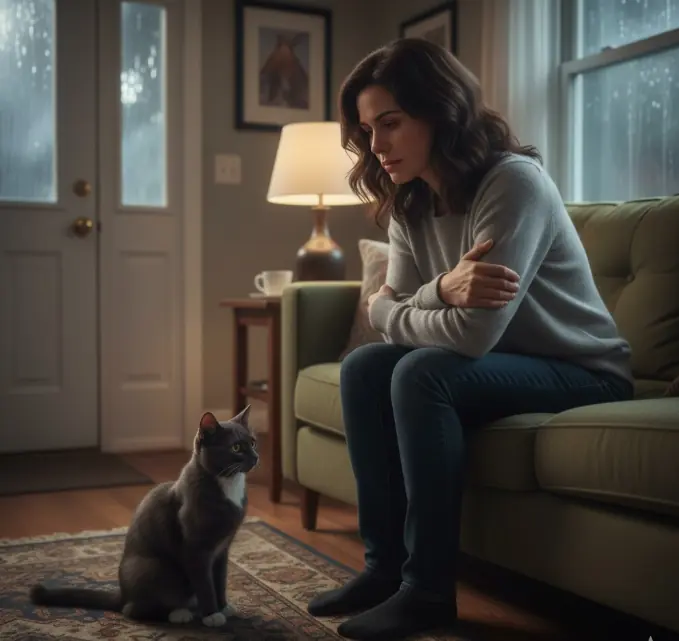
It was a drizzly Thursday evening in late August. I was sitting on my porch in the suburbs of Seattle, nursing a cup of tea and watching the fog roll through the Douglas firs. Out of the corner of my eye, I saw a flicker of movement near the hydrangea bushes. A small, soot-colored cat with white "socks" on its front paws was sitting perfectly still, watching me.
My first instinct wasn't warmth. It was resistance. "Go home," I said, my voice sounding raspy even to my own ears. "I don't have anything for you."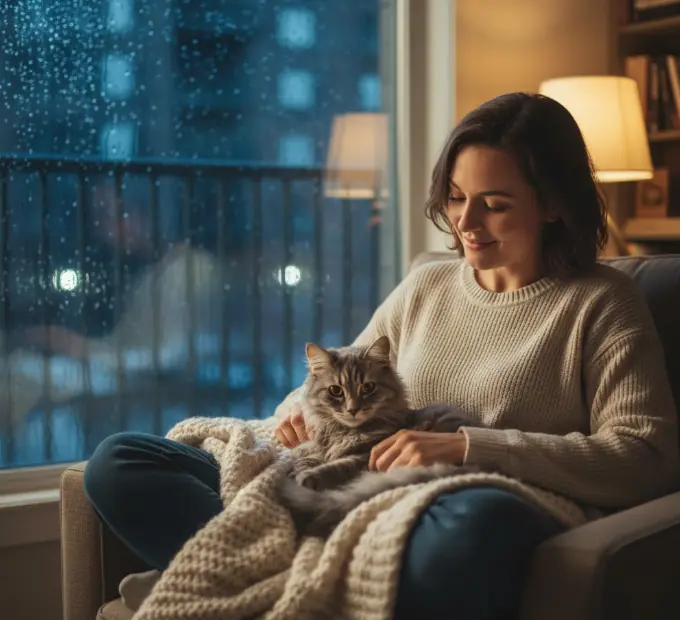
The cat didn't move. It didn't meow or beg. It simply blinked, its emerald-green eyes reflecting the dim porch light with a calm, unnerving steady gaze. I went inside and locked the door, feeling a strange sense of guilt that I quickly suppressed. I wasn't ready. I didn't want the responsibility, the attachment, or the inevitable goodbye.
The next morning, the cat was back. It was sitting on the top step of the porch, tucked into a neat loaf. When I stepped out to get the mail, it didn't run away. It just shifted slightly to give me room to pass.
"I told you," I muttered, looking down at the small creature. "The kitchen is closed."
I spent the next week engaged in a silent war of wills. The cat—whom I refused to name—became a permanent fixture of my landscape. It was there when I drank my morning coffee. It was there when I returned from work, sitting on the garden wall like a gargoyle. It never tried to come inside, and it never made a sound. It was just a presence, a quiet persistent reminder that life was happening just outside my door.
I found myself doing things I promised I wouldn't. I noticed the cat was looking thin, its ribs visible beneath the dark fur. I told myself that feeding it didn't mean I was "keeping" it; it was just a humanitarian act. I bought a single can of tuna and placed it on the far edge of the porch.
I watched through the window as the cat ate. It didn't bolt the food down like a stray; it ate with a slow, deliberate grace that reminded me painfully of Oliver. When it was finished, it looked at the window, gave a single, short lick to its paw, and curled up right there on the wooden planks.
"It’s just for now," I told the empty kitchen. "Until the weather clears."
But the weather didn't clear, and neither did the grief. Instead, they began to coexist. I started talking to the cat through the screen door. I told it about my day, about the project I was working on, and eventually, I told it about Oliver. I told it about the way Oliver used to hide in laundry baskets and how he hated the sound of the vacuum cleaner.
The cat listened. It really did. It would tilt its head, its ears twitching at the sound of my voice. It didn't offer the familiar, boisterous comfort of a new pet; it offered something more profound: a witness to my mourning. It sat in the space where my grief lived and didn't try to pull me out of it. It just sat with me.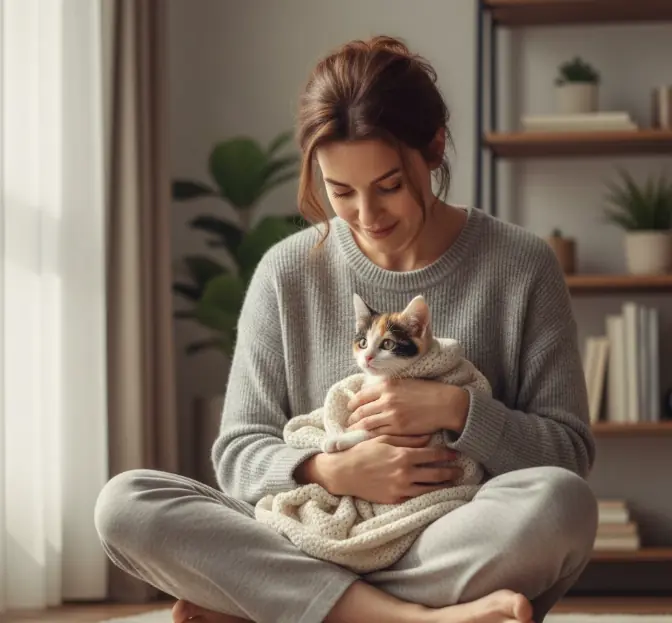
One evening, a heavy thunderstorm broke over the city. The wind lashed the trees, and the rain turned the porch into a river. I paced my living room, looking at the door. I knew the cat was out there, tucked into the small corner behind the wicker chair. I thought about the cold, the damp, and the fragility of such a small life.
I opened the door.
The cat was shivering, its fur spiked with raindrops. It looked up at me, and for the first time, I saw a flicker of uncertainty in those green eyes.
"Okay," I sighed, stepping back. "Just for tonight. Just until it stops raining."
The cat walked in with a cautious, respectful gait. It didn't explore the house or jump on the furniture. It found a small rug near the door, sat down, and began the long process of grooming itself dry. I sat on the sofa across from it, feeling a strange mixture of vulnerability and relief.
The silence of the house felt different that night. It wasn't the heavy, suffocating silence of loss. It was a shared silence.
As the weeks passed, the "just for tonight" turned into a permanent arrangement. I stopped calling it "the cat" and started calling it Shadow. It wasn't Oliver. It didn't sleep in the same spot, it didn't like the same treats, and it had a completely different personality—more reserved, more observant, more independent.
I realized that my fear of getting another pet was based on a misunderstanding of love. I had thought that bringing a new life into my home would be an act of replacement—a way of trying to overwrite the memory of Oliver. I felt like if I loved again, I was somehow being unfaithful to the fifteen years I had shared with my old friend.
But Shadow showed me that love isn't a zero-sum game. The heart isn't a room with limited space; it’s an accordion that expands to fit whatever music is playing. Shadow wasn't a replacement; he was a sequel. He was a new chapter in a book that I thought had ended.
One afternoon, I was sitting at my desk, and Shadow jumped up, settling himself quietly next to my keyboard. He rested his head on my wrist, a soft, warm weight that felt hauntingly familiar yet entirely new. I looked at him and felt a sudden, sharp pang of love—the kind of love that comes with the knowledge of future loss.
But this time, I didn't pull away. I didn't try to shield myself. I realized that the pain of saying goodbye is only possible because of the beauty of the hello. To close myself off to companionship to avoid the ending was to miss the entire story.
Oliver was gone, and I would always carry that piece of him in my heart. His place on the corner of the bed remained his, a sacred memory. But Shadow had found a new place—a spot on the rug, a perch on the desk, and a quiet corner of my spirit that I hadn't realized was still open.
I didn't want another pet after losing my cat, and in a way, I was right. I didn't need a "replacement." I needed a teacher. I needed a quiet, soot-colored stray to show me that healing doesn't mean forgetting; it means moving forward with your memories tucked under one arm and a new friend under the other.
Love had returned to my home, not in the form I expected, but in the form I needed. As the sun set over the fir trees, casting a long shadow across the room, I reached out and stroked Shadow’s ears. He purred—a rusty, unique sound that belonged only to him—and I finally let the last of the silence go.