Our grumpy old cat pretended not to care until the day I needed her most
Our grumpy old cat pretended not to care until the day I needed her most
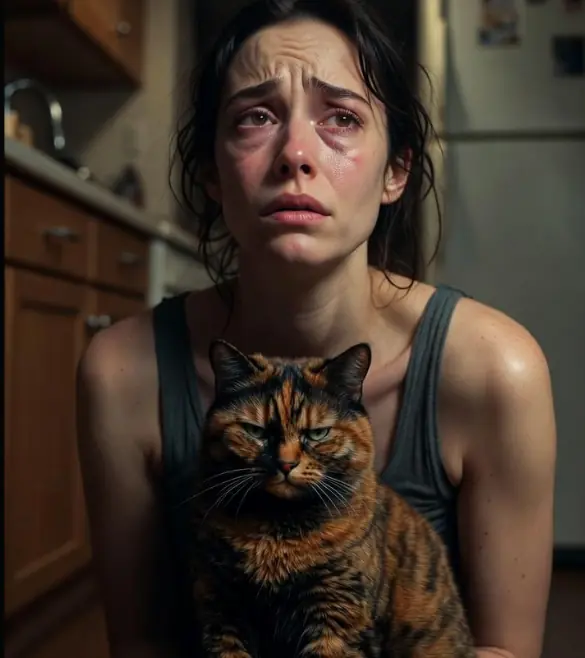
In the grand hierarchy of our household, Matilda sat comfortably at the top, though she rarely bothered to acknowledge the subjects she ruled over. She was a fourteen-year-old tortoiseshell with a face that looked like it had been permanently carved into a scowl and a coat that resembled a scorched patchwork quilt. Matilda was not a "lap cat." She was not a "purr-on-command" cat. She was an architectural feature—a silent, furry gargoyle who watched the world from the top of the bookshelf with a look of profound, weary disappointment.
My husband, Leo, and I had a running joke that Matilda was actually a retired Victorian headmistress reincarnated into a feline body. She didn't seek out affection; she tolerated it in small, precisely measured doses. If you tried to pet her for longer than exactly forty-five seconds, she would simply stand up, give you a look that suggested you had just committed a grave social faux pas, and walk away with a flick of her tail.
"She doesn't love us," Leo would often laugh as he watched her snub a high-end salmon treat. "She just keeps us around because we’re the only ones in the house who know how to operate the can opener."
I used to agree. I grew up with Golden Retrievers who would practically turn themselves inside out with joy the moment I walked through the door. Matilda was different. She was a shadow, a ghost who only materialized when the kibble hit the ceramic bowl. She lived for two things: the sunbeam that hit the rug at 2:00 PM and the undisturbed quiet of her favorite cardboard box. I loved her, of course, but it was a distant kind of love—the kind you feel for a difficult relative you see once a year.
Then came the year that felt like a long, relentless winter for my soul.
It started with a series of professional setbacks that left me feeling drained and hollow. Then came a health scare with my mother back home, followed by a month of sleepless nights and vibrating anxiety. By the time November rolled around, I felt like a glass that had been tapped too many times; I was covered in invisible cracks, just waiting for the final vibration to shatter me.
That final vibration came on a Tuesday evening. I had received a particularly discouraging phone call, and the weight of the last six months finally became too heavy to carry. Leo was out for the evening, and the house was draped in a thick, oppressive quiet. I sat down on the kitchen floor—not because it was comfortable, but because I simply didn't have the energy to make it to the sofa.
I pulled my knees to my chest and leaned my head back against the cold wooden cabinets. And then, I started to cry. It wasn't a soft, cinematic weep; it was a messy, gasping sob that came from the very bottom of my lungs. I felt completely, profoundly alone. I felt like the world had moved on without me, and I was just a ghost in my own kitchen.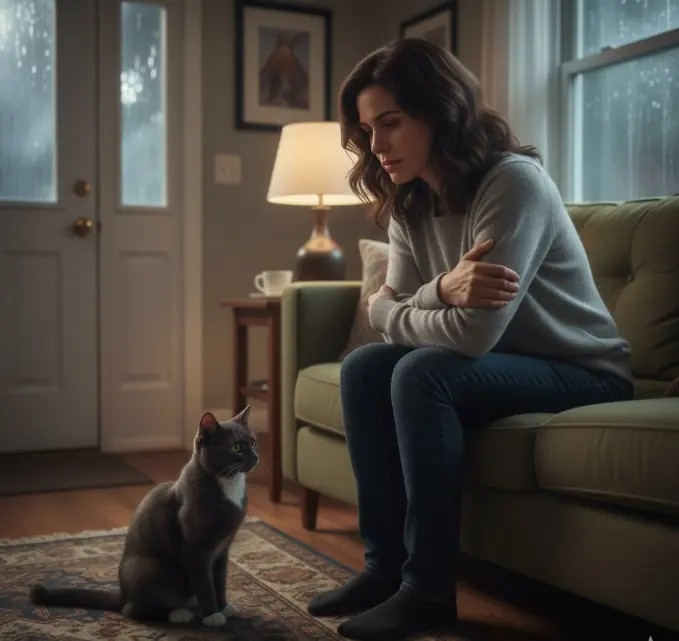
In the middle of my breakdown, I saw a flash of orange and black out of the corner of my eye.
Matilda had been napping on her bookshelf in the other room. Usually, any loud noise or sudden display of human emotion was her cue to retreat even further into the shadows. She hated drama. She hated noise. I expected her to vanish into the bedroom, annoyed that her evening slumber had been interrupted by my hysterics.
Instead, she hopped down. I heard the soft thud of her paws on the hardwood. I watched, through blurry eyes, as she walked slowly across the kitchen floor. She didn't run; she moved with her usual regal deliberation, her tail twitching slightly.
She stopped about two feet away from me and sat down. She stared at me with those wide, amber eyes—eyes I had always thought were cold. For a long minute, she just watched me cry. I felt a surge of embarrassment. "Go away, Tilly," I whispered, wiping my nose with my sleeve. "I'm a mess. Go find a sunbeam."
Matilda didn't move. Then, she let out a sound I hadn't heard in years—a soft, urgent trill. She stood up, walked into the space between my knees, and did something she had never done in the fourteen years we had owned her.
She climbed onto my lap.
She didn't just walk over me to get somewhere else. She stepped onto my thighs, circled three times, and then settled her weight down with a heavy, contented sigh. Her fur was soft against my hands, and her body was like a small, warm radiator.
I froze. I was so shocked that my sobbing actually stopped. "Tilly?" I whispered.
She didn't look up. She simply tucked her paws under her chest and started to purr. It wasn't the quiet, polite purr she gave when she was being fed. It was a deep, rumbling vibration that I could feel in my own bones. It was the sound of a heart beating for someone else.
I sat on that kitchen floor for nearly an hour. The floor was hard, and my legs were starting to go numb, but I didn't move. I couldn't. For the first time in months, the vibrating anxiety in my chest began to settle. The rhythmic, steady pulse of Matilda’s purr acted like a metronome, pulling my own frantic heart back into a steady pace.
She didn't leave. She didn't get bored after forty-five seconds. She stayed until my breathing was even and my eyes were dry. When I finally reached out to stroke her ears, she didn't flinch or walk away. She leaned into my touch, closing her eyes, as if to say, “I’m here. I’ve always been here.”
In that hour, the "grumpy old cat" narrative died. I realized that Matilda hadn't been "distant" for fourteen years; she had been observant. She had been the silent witness to my life, watching from her high perches, waiting for the moment when her particular brand of quiet companionship would be the only thing that could reach me.
After that night, everything changed.
The scowl was still there—Matilda wasn't about to undergo a total personality transplant—but the walls were gone. Small, affectionate gestures began to appear like wildflowers after a long drought. Now, when I’m working at my desk, she doesn't sit on the bookshelf; she sits on the edge of my laptop, occasionally reaching out a single paw to touch my hand. When I wake up in the morning, she is no longer a shadow in the corner; she is a warm weight at the foot of the bed, waiting for me to acknowledge the new day.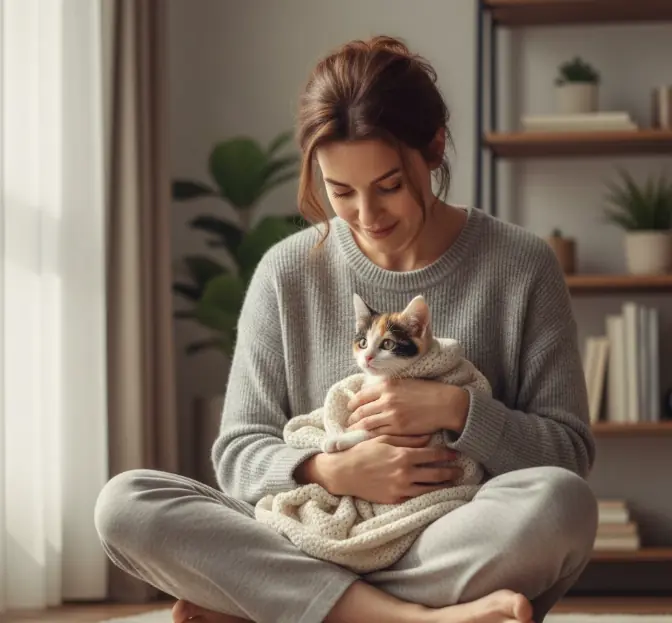
I realized that dogs love you with a bright, loud fire that is impossible to miss. But a cat—especially a grumpy, independent one like Matilda—loves you with a low, steady flame. It is a love that doesn't demand attention; it just provides warmth. It is the love of a silent guardian who doesn't need to bark to let you know they are protecting you.
Leo noticed the shift, too. One evening, he found us both on the sofa, Matilda draped across my chest like a living scarf.
"I thought she didn't care about us," he whispered, smiling.
"She cares," I said, stroking the scorched patchwork of her fur. "She just waited until the room was quiet enough for us to hear it."
I am still a person who is covered in cracks, but they don't feel so dangerous anymore. I have a fourteen-year-old gargoyle who has decided that her new favorite perch is right next to my heart. I’ve learned that companionship doesn't always need words, and it doesn't always need to be loud. Sometimes, the most profound love is the kind that sits with you on a cold kitchen floor in the dark and refuses to leave until the light comes back.
Matilda is still Matilda. She still hates the vacuum, and she still thinks she is the headmistress of this house. But I know the truth now. Underneath that scowl and the scorched-fur coat is a soul that has been watching over me since the day we brought her home.
Family isn't just the people who talk to you; it’s the ones who know when to be silent with you. And as I listen to the steady, rhythmic rumble of her purr, I realize that I was never as alone as I thought I was. I just had to wait for the grumpiest member of the family to show me the way back to myself.