I rescued a stray cat, but i didn’t know she was rescuing me too
I rescued a stray cat, but i didn’t know she was rescuing me too
The apartment felt like a hollow shell of a place that winter. I had recently lost my job at the marketing firm—a "restructuring" they called it, though it felt more like an erasure. On top of that, the silence left behind after a long-term relationship crumbled was deafening. I spent my days in a cycle of half-hearted job applications and staring at the gray Philadelphia skyline, feeling like a ghost in my own life. I was brittle, exhausted, and convinced that my best years were behind me.
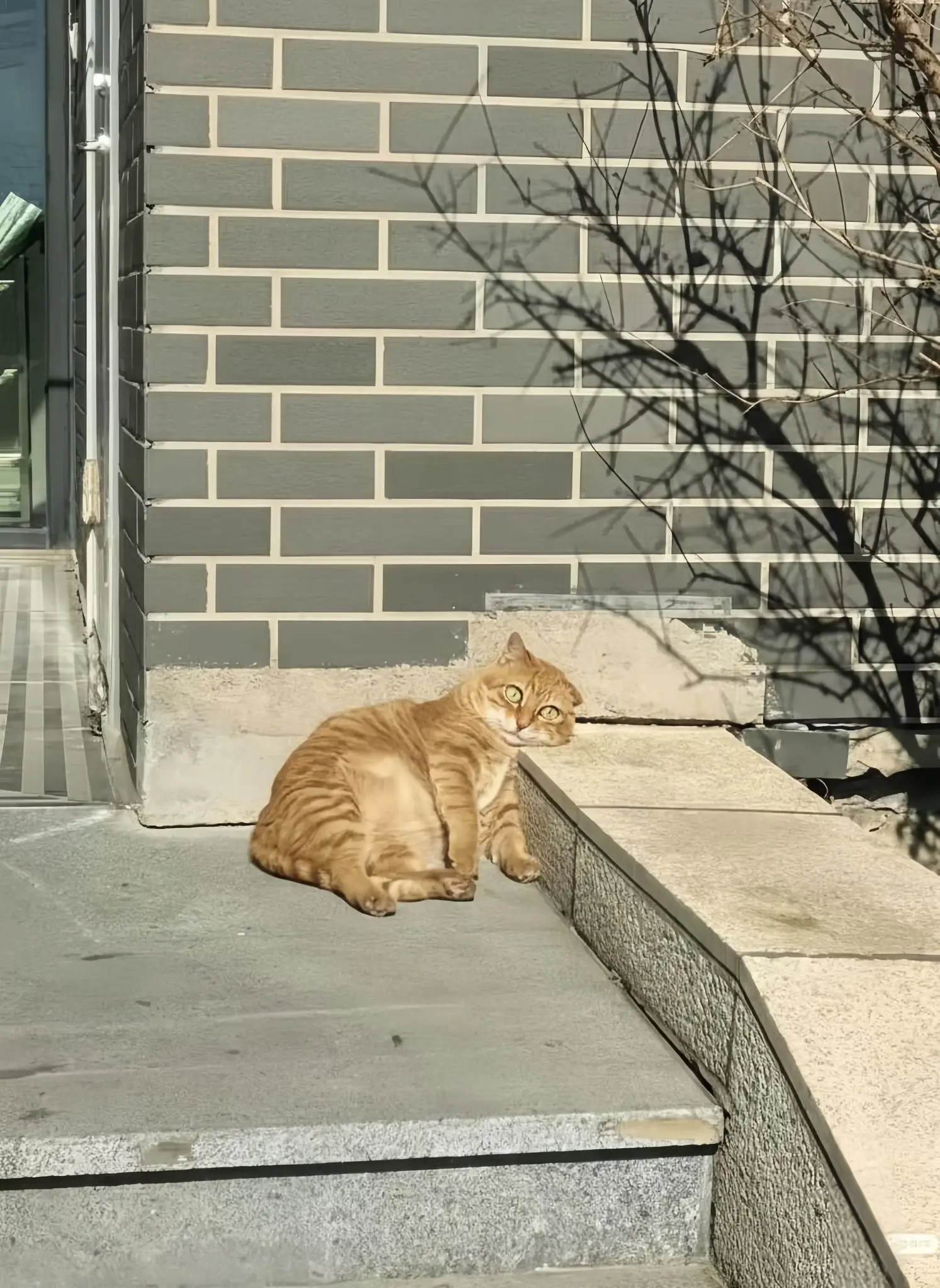
It was a rainy Tuesday night when I saw her near the dumpster. She was a bedraggled calico, her fur matted into damp clumps and her eyes wide with a wary, golden intelligence. She didn't meow; she just sat there, shivering with a quiet intensity that mirrored my own internal state.
"I can't even take care of myself," I whispered to the cold glass of my window. But ten minutes later, I was downstairs with a saucer of tuna and an old towel.
I named her Luna. At first, she was a source of more frustration than comfort. She was incredibly distant, hiding under the radiator for days on end, only emerging to eat when I left the room. Whenever I tried to approach her, she would let out a low, defensive hiss that felt like a personal rejection.
"See?" I thought, sitting on the kitchen floor in the dark. "Even a stray cat doesn't want anything to do with me."
The setbacks came quickly. During a particularly low week, when a final-round interview ended in a rejection letter, Luna stopped eating altogether. I had to take her to the vet, an expense I could ill afford with my dwindling savings. The bill for the exams and fluids felt like another blow to my crumbling stability. The vet told me she was severely dehydrated and suffering from a respiratory infection, but more than that, she was "emotionally shut down."
"She’s had a hard time," the vet said softly. "It takes time to trust when you’ve been let go."
The irony wasn't lost on me.
For the next two weeks, my life became a series of small, exhausting tasks centered around Luna. I had to administer medicine twice a day—a battle of wills that usually ended with me covered in scratches and her retreated further into the shadows. I felt a crushing sense of doubt. I was pouring my limited energy into a creature that seemed to hate me, in an apartment I wasn't sure I could keep, while the world outside felt increasingly indifferent to my existence.
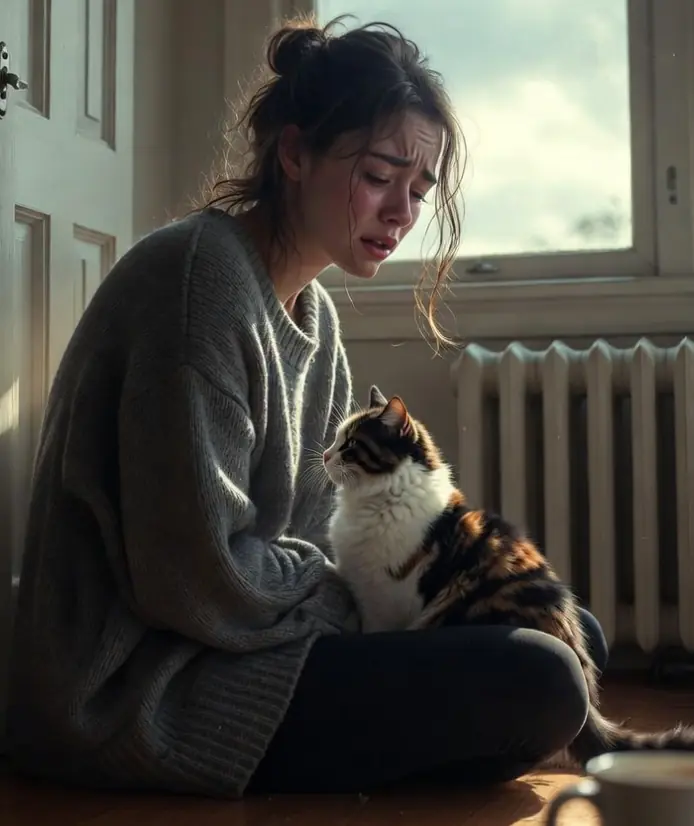
I was at my breaking point on a Friday evening. I had spent the day dealing with insurance paperwork and a leaking sink, and the weight of it all finally felt too heavy to carry. I slumped against the wall in the hallway and let the tears come—those jagged, ugly sobs that you only let out when you think you’re truly alone. I felt like a failure in every sense of the word.
Then, I felt something.
It was a soft, hesitant pressure against my knee. I opened my eyes and saw Luna. She wasn't hissing. She wasn't hiding. She was standing right there, her matted fur finally beginning to smooth out, watching me with those amber eyes. Slowly, she leaned her head against my leg and let out a tiny, rusty purr.
It was the first time she had touched me. In that moment of near hopelessness, her small gesture felt like a lifeline thrown across a dark canyon. She wasn't just a "stray" I was saving; she was a witness to my pain, and for the first time in months, I didn't feel invisible.
Caring for her became the turning point in my own healing journey. Because she needed a routine, I created one. I woke up at 7:00 AM to feed her, which meant I had to get out of bed. I kept the apartment clean because she was sensitive to dust. I started talking to her—at first just narrating my day, but eventually, I found myself telling her things I couldn't say to anyone else. I was practicing vulnerability on a creature that didn't judge.
The "emotional twist" came a month later. Luna had become my constant shadow, sleeping at the foot of my bed and meeting me at the door whenever I returned from the grocery store. I was brushing her one afternoon when I noticed something tucked into the thick fur of her neck. It was a small, faded scar, and next to it, a tiny, almost invisible tattoo—the kind used by shelters to indicate a pet had been microchipped.
I took her back to the vet to have the chip scanned. I expected to find a long-lost owner who had been searching for her, and a part of me was terrified I’d have to give her up. But the vet found something different.
"She was part of a 'seniors for seniors' program," the vet explained, looking at the screen. "Her owner was an elderly woman who passed away six months ago. Luna sat in that apartment for two weeks before anyone found her. No wonder she was so shut down. She didn't just lose her home; she lost her person."
The revelation hit me like a physical blow. Luna hadn't been born on the streets; she had been a cherished companion who had experienced a loss far greater than mine. She had known love, lost it, and survived the silence of an empty home.
In that moment, I looked at her and didn't see a "project" or a "stray." I saw a mirror. We were both survivors of a life that had suddenly changed. We were both learning how to be okay in the quiet.
Discovery that she had been loved before gave me a strange kind of hope. It meant that love wasn't a one-time thing; it was something that could be rebuilt, even after it felt like the world had ended. If Luna could find the courage to trust a stranger after everything she’d been through, then maybe I could find the courage to try again, too.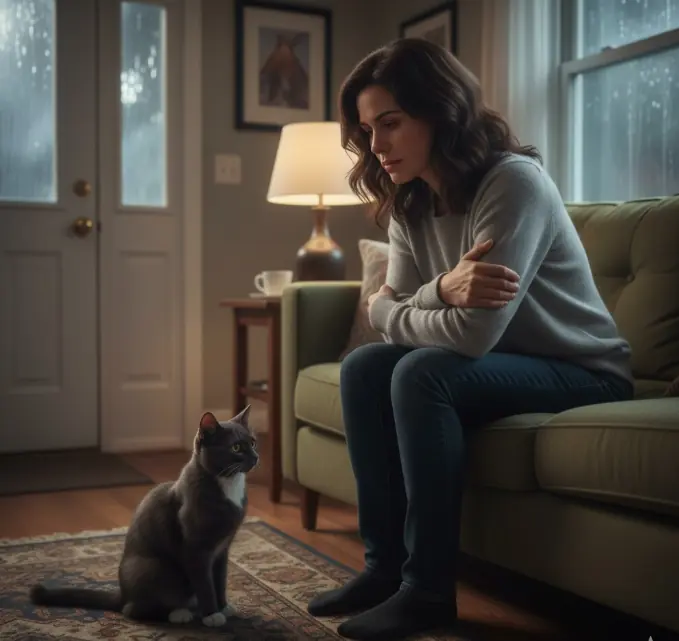
A week later, I landed a freelance contract that eventually turned into a full-time position. My bank account started to recover, and the "hollow" feeling in the apartment was replaced by the steady, comforting presence of a cat who knew exactly when I needed a nudge of a cold nose.
I rescued a stray cat from a dumpster, but the truth is much more profound. Luna rescued me from the paralyzing fear that I was no longer needed. She gave me a reason to stay present when I wanted to disappear. She taught me that resilience doesn't have to be loud; sometimes, it’s just the act of showing up for breakfast.
I am no longer the brittle woman who sat on the floor and cried in the dark. I am stronger, more patient, and infinitely more grateful. Luna is curled up on my lap as I write this, her purr a rhythmic reminder of how far we’ve both come. We are no longer two fractured things trying to survive the winter. We are a family, and as the spring sun begins to hit the window, I realize that the best way to heal is to find someone else who needs a little light—and then, together, you just keep walking toward the sun.