I never wanted a dog now i can’t imagine my life without him
I never wanted a dog now i can’t imagine my life without him
I am a person of order. I like my floors vacuumed in straight lines, my shoes organized by color, and my weekends defined by silence and a hot cup of black coffee. For thirty-eight years, my home was a fortress of tranquility—until my seven-year-old son, Toby, discovered the concept of "unconditional love" via a local animal shelter's Facebook page.
"He has sad eyes, Dad," Toby whispered, shoving a tablet under my nose. "And his name is Barnaby. He looks like he needs a hug."
I looked at the photo. Barnaby looked like a chaotic mix of a golden retriever and a caffeinated squirrel. His ears were pointing in two different zip codes, and his tongue was hanging out at an angle that suggested he had never once had a coherent thought.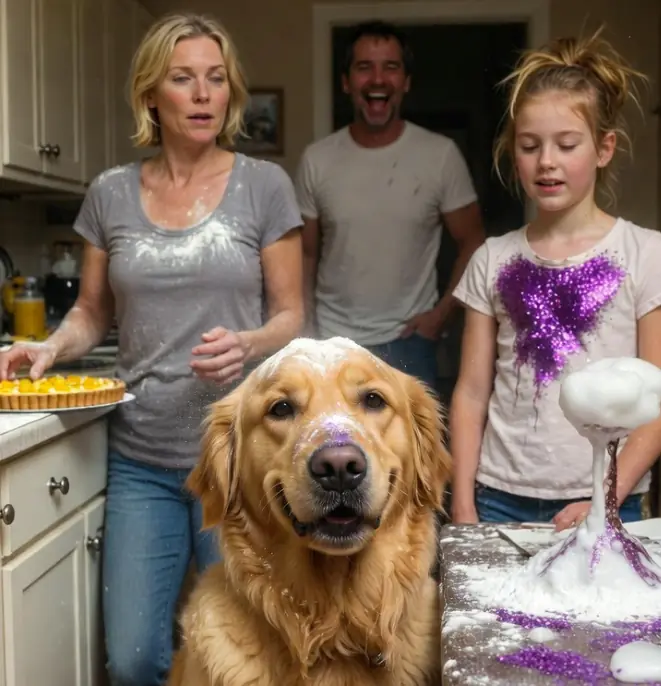
"Toby, buddy, dogs are a lot of work," I said, trying to be the voice of reason. "They shed. They bark. They eat things that aren't food. We are a 'no-shed' and 'quiet' household."
But Toby has a superpower: the silent, trembling lip. By Saturday morning, I was at the shelter, signing papers and questioning every life choice I had ever made. I told myself I was doing this for my son. I told myself it was a "growth experience." I didn't realize that the only thing growing would be my blood pressure.
The first month of Barnaby's residency was a masterclass in domestic catastrophe.
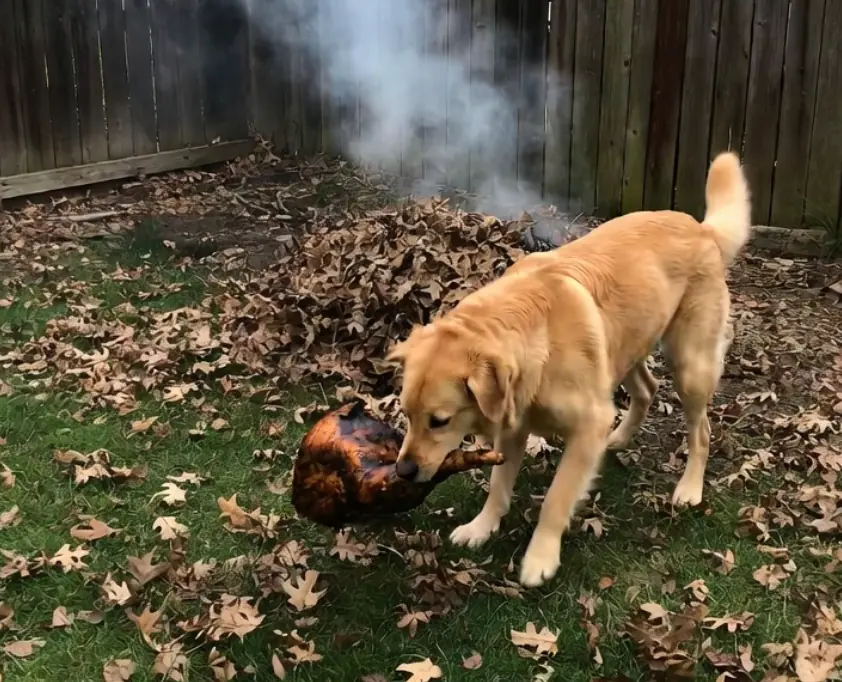
Barnaby didn't just walk; he vibrated. He possessed a level of hyperactivity that defied the laws of physics. Within forty-eight hours, he had chewed through a pair of my favorite Italian leather loafers—the ones I only wear for important meetings. I found him in the living room, surrounded by a confetti of expensive calfskin, looking at me with those "sad eyes" that now just looked like he was asking, "What’s next on the menu, Boss?"
Then there were the flower pots. I had spent years cultivating a row of prize-winning begonias on the patio. Barnaby decided they were actually hidden treasures waiting to be unearthed. I came home to a scene of floral carnage, with dirt smeared across the sliding glass doors and a dog who was now more brown than golden, wagging his tail as if expecting a gold medal for his archeological efforts.
"He’s just adjusting!" Toby would shout, throwing his arms around the mud-caked beast.
"He’s adjusting the value of our house, Toby," I’d groan, reaching for the vacuum for the fourth time that day.
The neighbors weren't thrilled either. Barnaby had a "voice" like a foghorn, and he enjoyed using it at 3:00 AM whenever a particularly suspicious-looking leaf blew across the sidewalk. I spent my mornings apologizing to Mrs. Higgins next door and my evenings wondering if the shelter had a "no-questions-asked" return policy. I felt overwhelmed, frustrated, and deeply regretful. I was the man with the straight-line vacuum marks, and now I was the man with a shredded rug and a dog that barked at clouds.
The turning point arrived on a bright, crowded Saturday in October.
We had gone to the city park for the Fall Festival—a sprawling maze of pumpkin patches, hayrides, and thousands of people. Barnaby was with us, of course, straining at his leash and trying to greet every single human being as if they were a long-lost relative.
The chaos of the festival was overwhelming. One moment, Toby was holding my hand, pointing at a giant inflatable slide. The next, a group of teenagers in costumes crowded past us, and my hand was suddenly empty.
"Toby?" I called out, turning in a circle.
No answer.
"Toby!"
The silence that followed was the most terrifying sound I’ve ever heard. In a crowded park, a seven-year-old can disappear in seconds. Panic, cold and sharp, flooded my chest. I started running toward the slide, shouting his name, my eyes frantically scanning the sea of coats and hats. Sarah, my wife, was white as a sheet, her voice cracking as she called out for him.
"Barnaby, sit!" I snapped, trying to keep the dog from tripping me.
But Barnaby wasn't vibrating anymore. He was still. His ears, usually flopping in different directions, were pinned forward. He let out a low, focused whuffle, his nose twitching with a frantic intensity. Before I could pull him back, he lunged—not with his usual chaotic energy, but with a terrifying, singular purpose.
"Barnaby, wait!"
He dragged me through the crowd, weaving between legs and strollers. He wasn't stopping for pets or looking for dropped popcorn. He was tracking. He led me away from the main stage, down a narrow path toward the edge of the woods where a small creek ran.
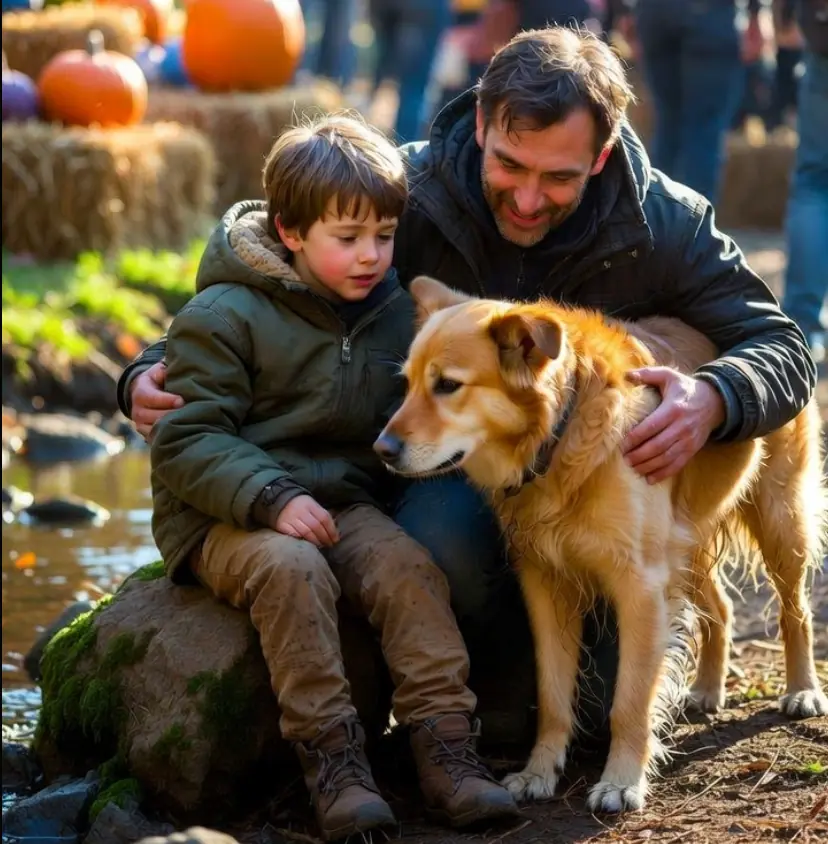
And there, sitting on a mossy rock near the water, looking very small and very frightened, was Toby. He had followed a stray balloon and gotten turned around in the trees.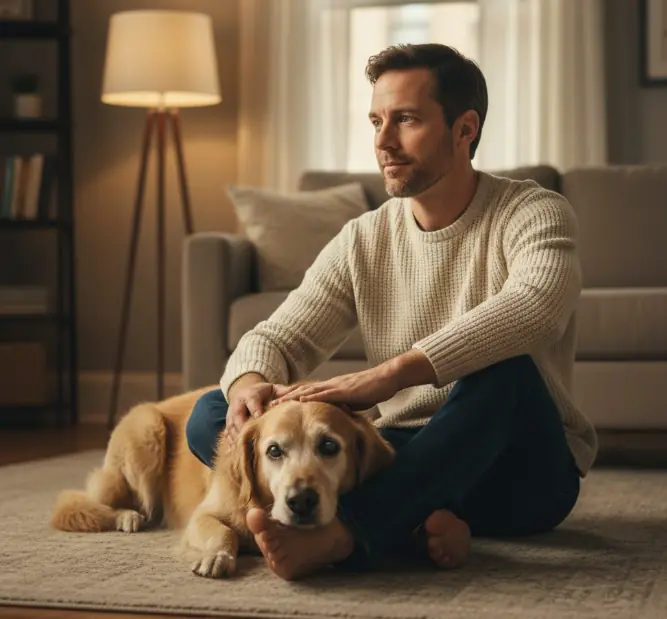
Barnaby didn't bark. He didn't jump. He just walked up to Toby and rested his large, goofy head on the boy's lap.
When I reached them, I didn't care about my shoes or my straight-line vacuum marks. I dropped to my knees in the dirt and pulled them both into my arms. Toby was crying, and I was shaking, and Barnaby just sat there, his tail thumping softly against the damp earth, looking at me with a quiet, steady gaze.
In that moment, I didn't see a "piece of trouble." I didn't see a "chewer of loafers" or a "destroyer of begonias." I saw the soul of our family.
I realized that while I had been busy guarding my order and my silence, Barnaby had been busy guarding us. He didn't love us because we were organized; he loved us because we were his. His hyperactivity wasn't malice; it was just an excess of joy that he didn't know how to contain.
The drive home was quiet. Toby fell asleep in the backseat, his hand resting on Barnaby’s flank. I looked at the dog in the rearview mirror. He was looking out the window, his ears back to their usual zip-code-defying positions.
"You're a good boy, Barnaby," I whispered.
He let out a long, contented sigh and closed his eyes.
It’s been six months since the festival. My house is no longer a fortress of tranquility. There are dog toys under the sofa, a permanent "nose smudge" on the bottom of every window, and I’ve accepted that my begonias will always be a work in progress. My shoes are kept on a high shelf now, and I’ve learned to embrace the "thwack-thwack" of a tail against the drywall.
I thought I didn't want a dog. I thought I didn't have room for the mess and the noise. But I was wrong. I was so incredibly wrong.
Barnaby taught me that a life without mess is often a life without movement. He taught me that "unconditional love" isn't a concept on a Facebook page; it’s a living, breathing, shedding reality that greets you at the door every day as if you’ve just returned from a heroic voyage.
I am a man who still likes a clean floor, but I’ve learned that a few paw prints are a small price to pay for a heart that is full. I can't imagine my life without the chaos. I can't imagine a weekend without a long walk or a morning without a wet nose waking me up.
We are the Millers, and we are no longer a "quiet" household. We are a loud, messy, happy pack. And as I sit here today with a cup of coffee and a dog resting his chin on my foot, I realize that the best things in life aren't the ones that fit into a color-coded box—they’re the ones that break the box entirely and show you a world you never knew you were missing.