We thought our cat was sick, but she was trying to tell us something
We thought our cat was sick, but she was trying to tell us something
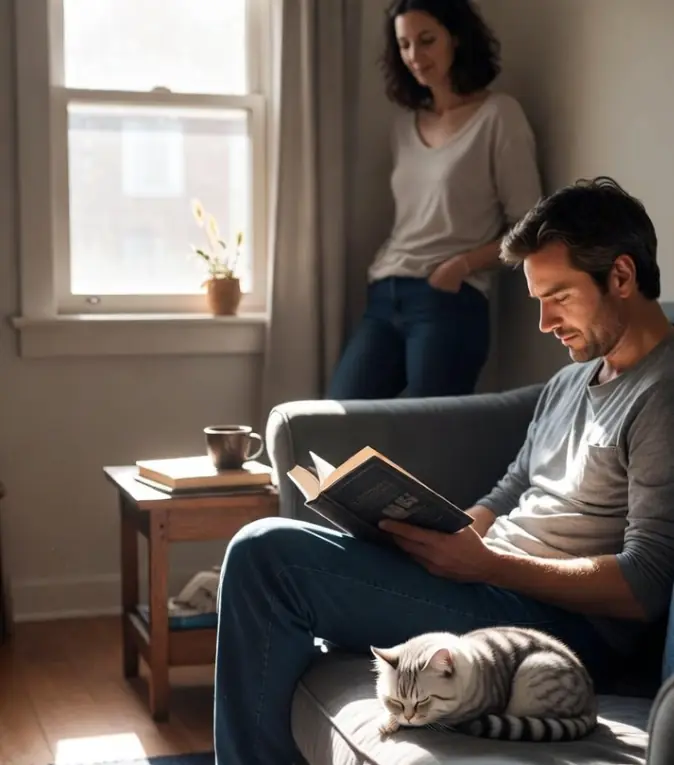
The first sign that something was wrong with Luna was the silence. Usually, our three-year-old calico was a living, breathing alarm clock. At precisely 6:30 AM, she would perform what we called the "gravity test" on my nightstand, systematically batting my chapstick, my glasses, and finally my phone onto the floor until I rose to fill her crystal bowl. But on that Tuesday morning in March, I woke up to a room that was eerily still. My glasses were right where I had left them, and the house felt heavy with a quiet I couldn't quite name.
"Luna?" I called out, my voice raspy with sleep.
There was no answering trill. No soft thud of paws hitting the carpet. When I walked into the kitchen, her ceramic bowl was untouched, the kibble from the night before sitting in a perfect, stale mound.
For a cat whose personality was roughly ninety percent appetite and ten percent mischief, this was the feline equivalent of a red alert.
By Wednesday, the concern in our house had shifted from mild curiosity to a thick, palpable anxiety. Luna wasn't just skipping meals; she was acting like a stranger in her own home. She had become distant, avoiding the sun-drenched sofa where she usually spent her afternoons. Instead, she was hiding in unusual places—under the guest bed, behind the heavy velvet curtains in the dining room, and once, inside a cardboard box in the back of the dark pantry.
"She won't even look at her favorite feather toy, Mom," my eight-year-old daughter, Chloe, whispered that evening. She was sitting on the floor by the guest bed, peering into the shadows with tears brimming in her eyes. "Do you think she’s mad at us? Or is she... is she going to leave?"
"She’s just not feeling well, honey," I said, trying to keep my voice steady even though my own heart was hammering against my ribs.
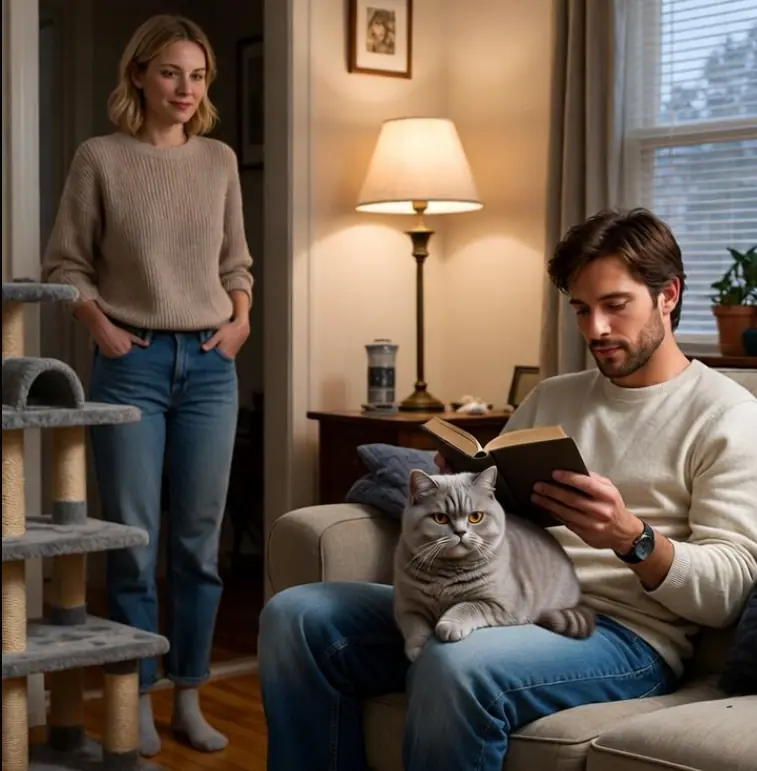
My husband, David, was equally unsettled. He was the one who had initially been "the dog person," but Luna had worked her way into his heart with a surgical precision. I found him in the hallway, staring at the empty space under the dining room table where Luna used to wait for him to drop a piece of cheese.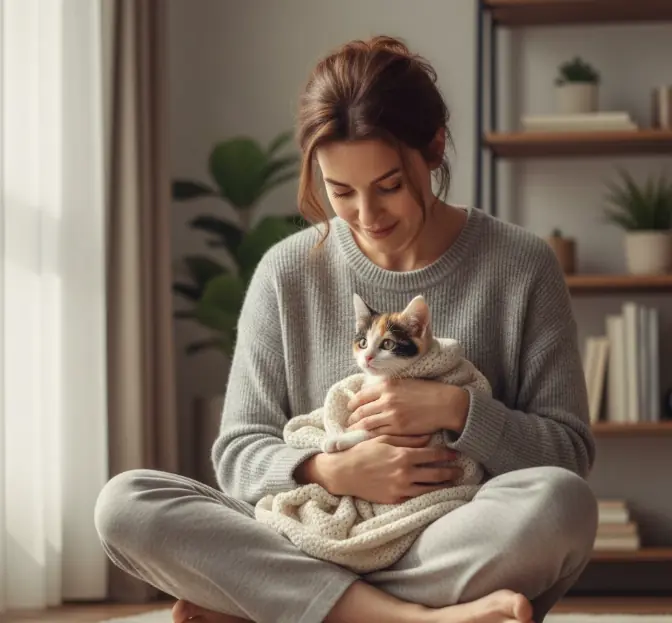
"I’ve checked all the usual things," David said, his brow furrowed with worry. "The plants haven't been chewed, the cabinets are locked. It’s like she’s just... fading away from us."
The drama of a sick pet is a quiet, agonizing thing. Because they cannot speak, every flick of a tail or turn of a head becomes a riddle you are desperate to solve. We spent our evenings in a state of suspended animation, the television off, the house quiet, all of us tuned to the frequency of a cat that was slowly withdrawing into herself. I felt a profound sense of failure. How could I have missed the signs? What if we were too late?
The suspense reached a breaking point on Thursday. Luna had retreated to the very back of the linen closet, buried deep behind a stack of old towels. When I tried to reach for her, she let out a low, mournful sound—not a hiss, but a soft, weary protest that made me pull my hand back as if I’d been burned.
"That’s it," David said, grabbing his keys. "I’m calling the emergency vet. We aren't waiting until the morning."
But as he reached for the closet door, Chloe let out a small, sharp gasp from the laundry room. "Mom! Dad! Come here! Look!"
We ran toward the laundry room, our hearts in our throats. I expected to see a spill, a broken window, or worse. Instead, I saw Chloe standing by the large, wicker basket where we kept the spare blankets. She was pointing toward the floorboards behind the dryer, near the vent that led outside.
There, tucked into a tiny gap where the baseboard had slightly pulled away from the wall, was a very small, very frantic ball of gray fluff.
It was a kitten.
A tiny, shivering stray, no more than five weeks old, had somehow crawled through the exterior vent and wedged itself into the warm, dark space behind our dryer. It was trapped, let out a high-pitched, microscopic "mew" that was so faint we had missed it over the hum of our daily lives.
And then, Luna appeared.
She didn't come out of the closet with the slow, lethargic movements of a sick animal. She moved with a focused, maternal urgency I had never seen. She pushed past our legs, went straight to the gap behind the dryer, and began to pace. She looked at us, then at the gap, her tail twitching with a frantic intensity.
The realization hit me like a physical wave of relief. Luna wasn't sick. She wasn't distant. She was exhausted.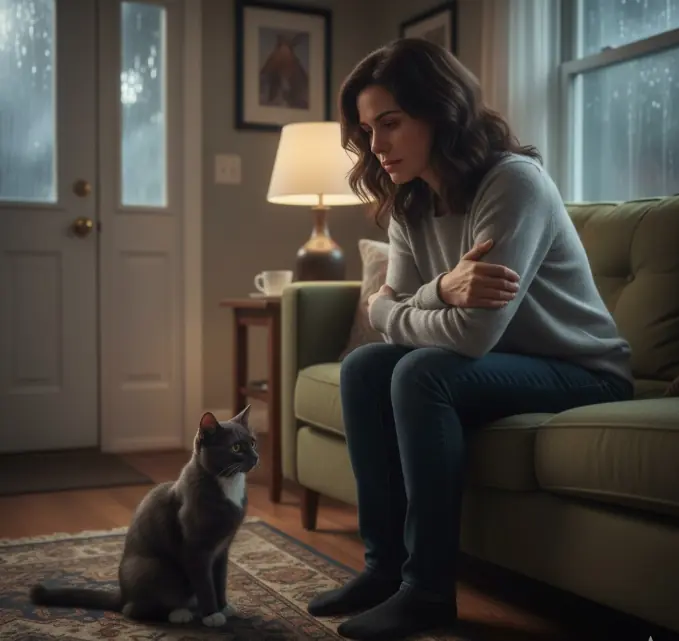
For three days, she had been standing guard over a trapped baby she couldn't reach. She hadn't been eating because she wouldn't leave her post. She had been hiding in unusual places because she was trying to find a way through the walls to the sound only her ears could hear. She had been "distant" because her entire world had narrowed down to the survival of a creature that wasn't even hers.
"She was trying to tell us," David whispered, his voice thick with emotion. "She wasn't hiding from us; she was trying to lead us here."
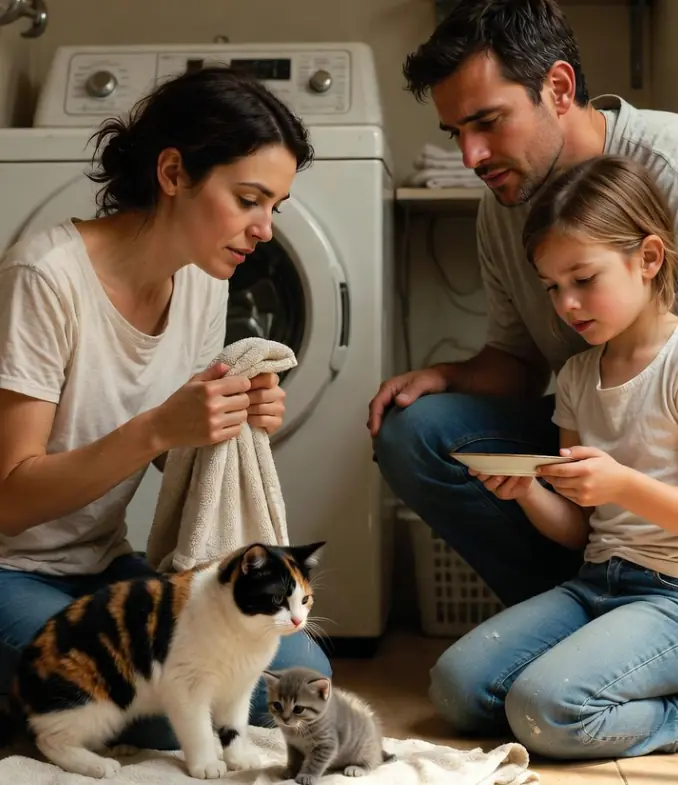
The fear that had gripped our family for seventy-two hours evaporated, replaced by a surge of purposeful energy. David carefully pulled the dryer away from the wall, and I reached into the gap with a soft towel. Within minutes, the tiny gray interloper was out—shaky, hungry, but perfectly fine.
The shift from terror to joy was instantaneous. Chloe ran to get a saucer of warmed milk, and David went to the pantry to find the kitten-sized carrier we’d kept from Luna’s early days.
But the most beautiful moment was watching Luna. As soon as the kitten was on the floor, she didn't act like a territorial cat. She walked over, let out a deep, rumbling purr, and began to lick the dust and lint off the kitten’s ears. She groomed that tiny stray with a ferocity that suggested she had been waiting three days to do exactly that.
Only then, once the kitten was safe and tucked into a warm bed of towels, did Luna finally walk over to her own crystal bowl. She ate with a gusto that made us all laugh through our lingering tears.
The gratitude we felt that night was profound. We weren't just thankful that Luna wasn't sick; we were thankful for the lesson she had taught us. We had spent three days worrying about our own loss—worrying about "our" cat and "our" feelings—while Luna had been practicing a selfless, quiet bravery. She had been a sentinel in the dark, refusing to give up on a life that everyone else had missed.
The comfort that settled over our home was deeper than anything we had felt in years. The "mysterious illness" had been a bridge that brought us all closer. We sat on the laundry room floor together, watching the two cats—the big calico and the tiny gray fluff—as they eventually curled up together in a single, purring heap.
"I think we have two cats now," David said, putting his arm around me.
"I think Luna already decided that three days ago," I replied.
A renewed sense of closeness filled the house. We realized that sometimes, the "unusual behavior" we see in those we love isn't a sign of withdrawal, but a sign of a burden they are carrying that we haven't yet learned to see. Luna taught us to listen to the silences, to look behind the curtains, and to trust that love often speaks in ways that don't require words.
As I go to bed tonight, the house is no longer eerily still. I can hear the soft, rhythmic thud of two sets of paws playing a gentle game of tag in the hallway. My glasses are on the nightstand, and my phone is safe, but I find myself wishing Luna would come and bat them off anyway.
We are the Millers, and our family has grown by four tiny paws. Life is a little noisier, our hearts are a little fuller, and we are finally, beautifully, all accounted for. Luna is no longer a ghost in the pantry; she is a hero in a sunbeam, and we have never loved her more.