I found a sick cat on a rainy evening and somehow it ended up saving me too
The rain in Seattle doesn't just fall; it settles into your bones. That Tuesday, the sky was the color of a bruised plum, and I was walking home with a heart that felt just as heavy. My apartment was a cavern of unfinished projects and cold coffee, a reflection of a year that had taken more than it had given. I was emotionally spent, retreating into a shell of isolation that felt safer than trying.
I heard the sound near a cluster of soggy cardboard boxes behind my building. It wasn’t a meow; it was a thin, ragged wheeze.
I stopped. My first instinct was to keep walking. I barely had enough energy to feed myself, let alone a creature that looked like it was losing a fight with the elements. "I can't," I whispered to the rain. "I just can't take on anything else."
But then, a pair of clouded, amber eyes met mine from beneath a wet flap of cardboard. The cat was a matted mess of grey fur, shivering so violently that it seemed to vibrate against the pavement. My exhaustion met his desperation, and for a second, the world narrowed down to just the two of us.
I sighed, unwrapped my scarf, and scooped up the trembling weight. He didn't even have the strength to hiss.
The first few days were a blur of uncertainty. I named him Barnaby. He spent most of his time tucked under my radiator, a tiny fortress of fear. The vet had been cautious—malnutrition, a respiratory infection, and a deep-seated distrust of humans. I spent my evenings sitting on the kitchen floor, a few feet away from his hiding spot, reading my books aloud so he would get used to the vibration of a human voice.
"I don't know what I'm doing, Barnaby," I confessed one night to the shadows. "We're both a bit broken, aren't we?"
Slowly, the rhythm of care began to change the rhythm of my life. I had to wake up at 7:00 AM to give him his antibiotics. That meant I had to get out of bed. I had to keep the apartment warm for his lungs, which meant I stopped sitting in the dark to save on the heating bill. I started buying fresh fish to tempt his appetite, and soon, I was cooking actual meals for myself instead of eating cereal over the sink.
Day ten was the turning point. I was sitting on the sofa, staring at the wall in a familiar wave of melancholy, when I felt a light, rhythmic pressure against my ankle. Barnaby had emerged. He didn't jump up, but he leaned his small, bony body against my leg. His purr was rusty, like an old engine trying to catch, but it was the most beautiful thing I had heard in months.
As his fur grew back soft and thick, the walls I had built around myself began to thin. Taking care of him required a presence of mind that left no room for my usual ruminations. I wasn't thinking about my past failures while I was cleaning his ears or marveling at the way he chased a stray sunbeam across the rug. I was simply there.
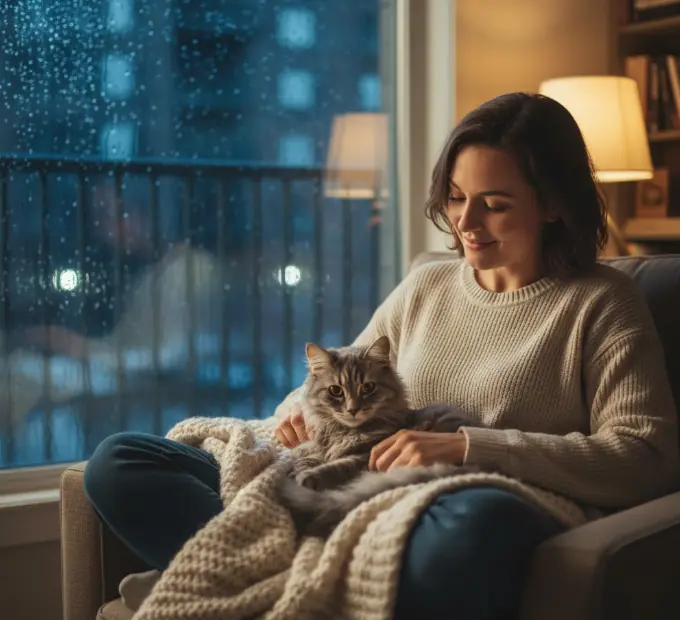
One evening, a month later, it started to rain again. I sat by the window with a cup of tea, and Barnaby hopped up onto my lap, kneading his paws into my fleece blanket before settling into a warm, heavy circle. The apartment didn't feel like a cavern anymore; it felt like a home.
I looked down at him, his amber eyes now clear and bright, and realized that while I had been monitoring his breathing and healing his infections, he had been quietly repairing the frayed edges of my spirit. I had stepped out into the rain to save a life, never imagining that the life I was truly rescuing was my own. We were no longer two solitary beings shivering in the dark; we were a family of two, anchored by a quiet, mutual trust that the world was finally, gently, okay.