Ethiopian Wolf Becomes First Known Carnivore to Act as a Pollinator
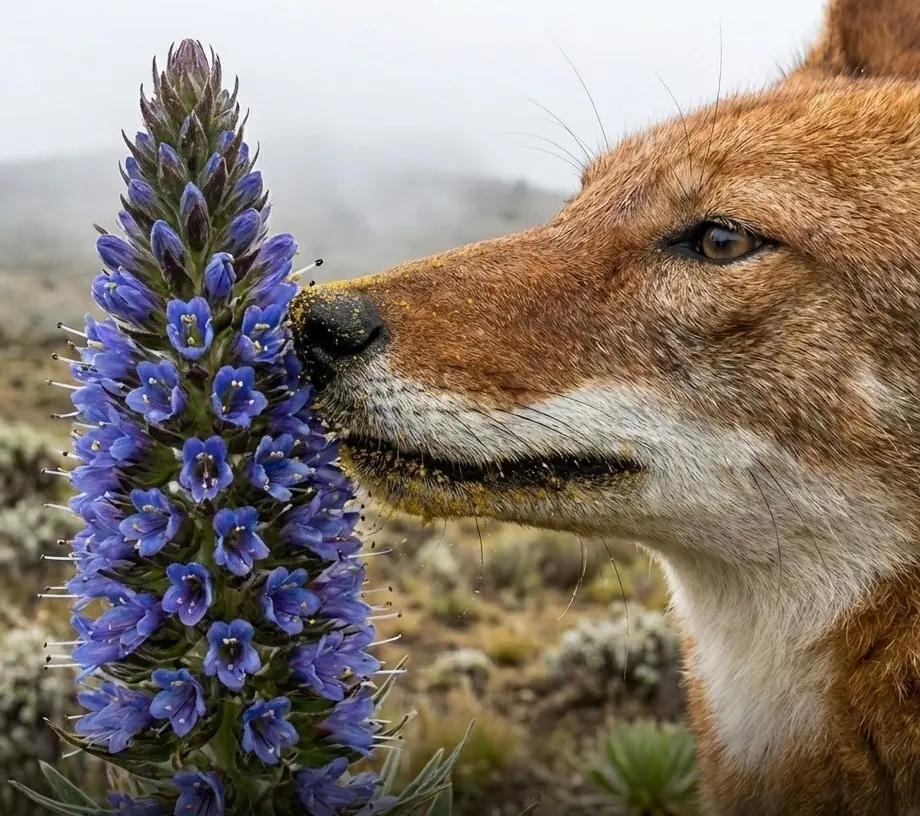
Scientists have made a surprising discovery involving the Ethiopian wolf, the world’s rarest wild dog. Known primarily as a meat-eater, this endangered carnivore has now been observed helping pollinate flowers — a behavior never before recorded in a large carnivore.
Researchers in the Ethiopian highlands noticed wolves feeding on the nectar of a tall blue flower that grows in alpine grasslands. As the animals pushed their noses into the blossoms, pollen stuck to their muzzles and fur. When the wolves moved from one plant to another, they unintentionally transferred the pollen, helping the plants reproduce.
This finding challenges the traditional idea that pollination is mainly done by insects, birds, and small mammals. It shows that even top predators can play an unexpected role in maintaining ecosystems.
The discovery also highlights the ecological importance of the Ethiopian wolf, whose population is estimated at fewer than 500 individuals in the wild. Conservationists warn that habitat loss, disease, and human activity continue to threaten the species.
Scientists say protecting the Ethiopian wolf is not only about saving a rare animal, but also about preserving a unique natural relationship that may be vital to the survival of certain highland plants.
“This shows how interconnected nature truly is,” one researcher said. “Even a carnivore can become a gardener.”